
By Michael Szerencsy
Most word games are finished the day they launch. The rules are set, the board is set, and every game after that is the same game with different letters. I understand why. A rule you never touch is a rule nobody argues with. But I've never been able to leave OUTLIER alone, and Uncharted is the clearest example yet of why.
The question I keep asking
OUTLIER started with one idea: in a word game, the rare word should win. Not the long word, not the fast word, the one almost nobody else would think of. Everything since has grown out of that, from the daily board to Outlier Live, where a room of players races the same ten rounds in real time.
Somewhere along the way I noticed a question I kept coming back to. If the letters are the same, what else could change? A crossword is a crossword. A Scrabble board in 1950 plays like one today. Word games have had remarkably few new ideas about what a word is worth, and I think that's a missed opportunity, not a law of nature.
What Uncharted is
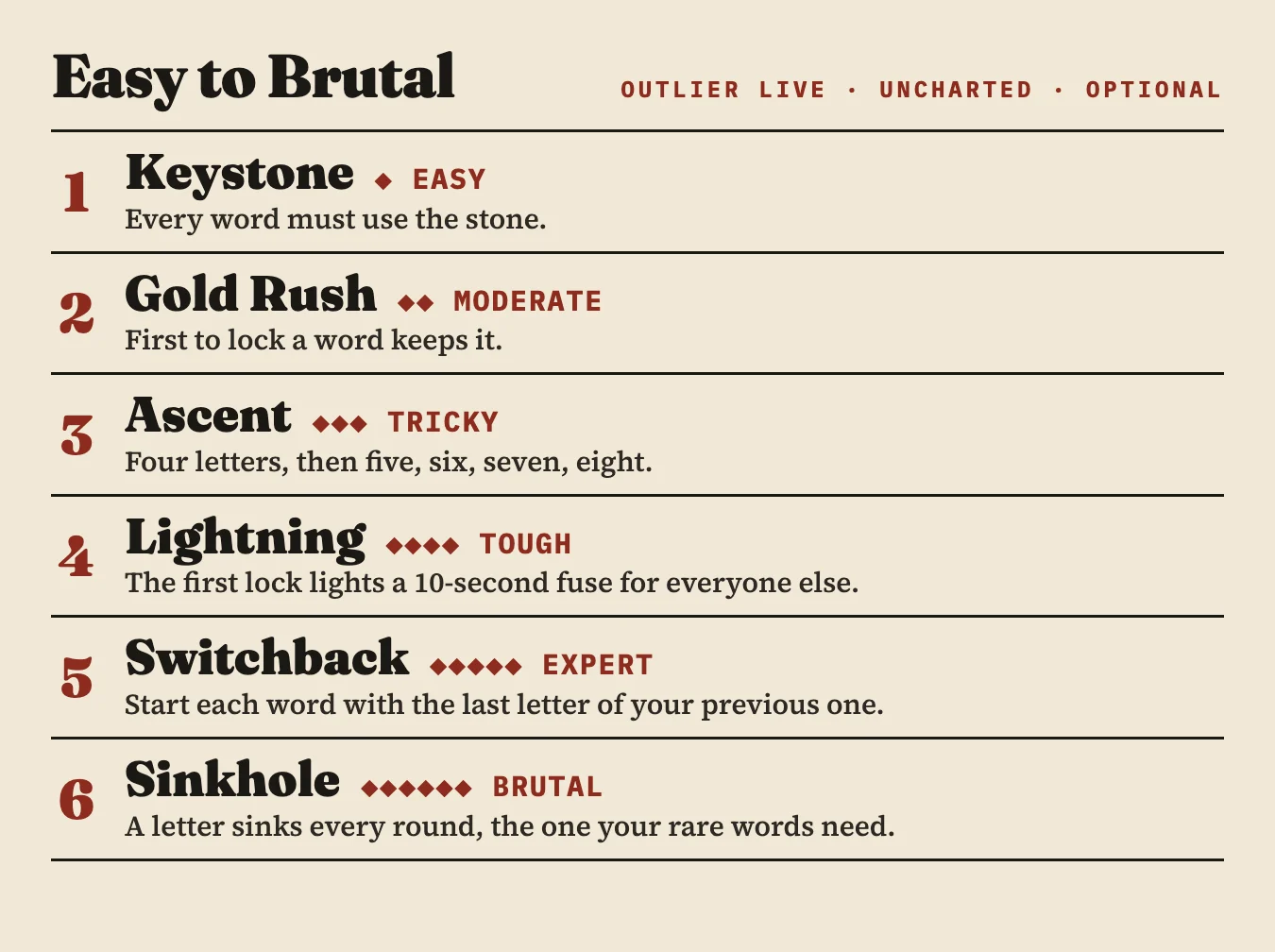
Uncharted is five new rules for Outlier Live, plus one new board. The rules sit on top of almost any board type, from Decoy to Deep Water (Keystone skips the shrinking boards), and change which words count. The board, Sinkhole, changes the letters themselves. Each one asks a different question of the same skill.
The name is the point. On an old map, the uncharted parts were the places nobody had drawn yet. That's how these feel to me: the same letters you've played a thousand times, with the edges of the map moved.
The six, from Easy to Master
Here they are from easiest to hardest. The levels come from real games: 53,281 words players locked in ordinary Live games, and what each rule would have cost them. Keystone cuts the most words but costs no points, because words through the stone score as well as any; Sinkhole takes away nearly every rare word by round 10. All six are completely optional: regular Live games haven't changed, so start with Easy, or skip them altogether.
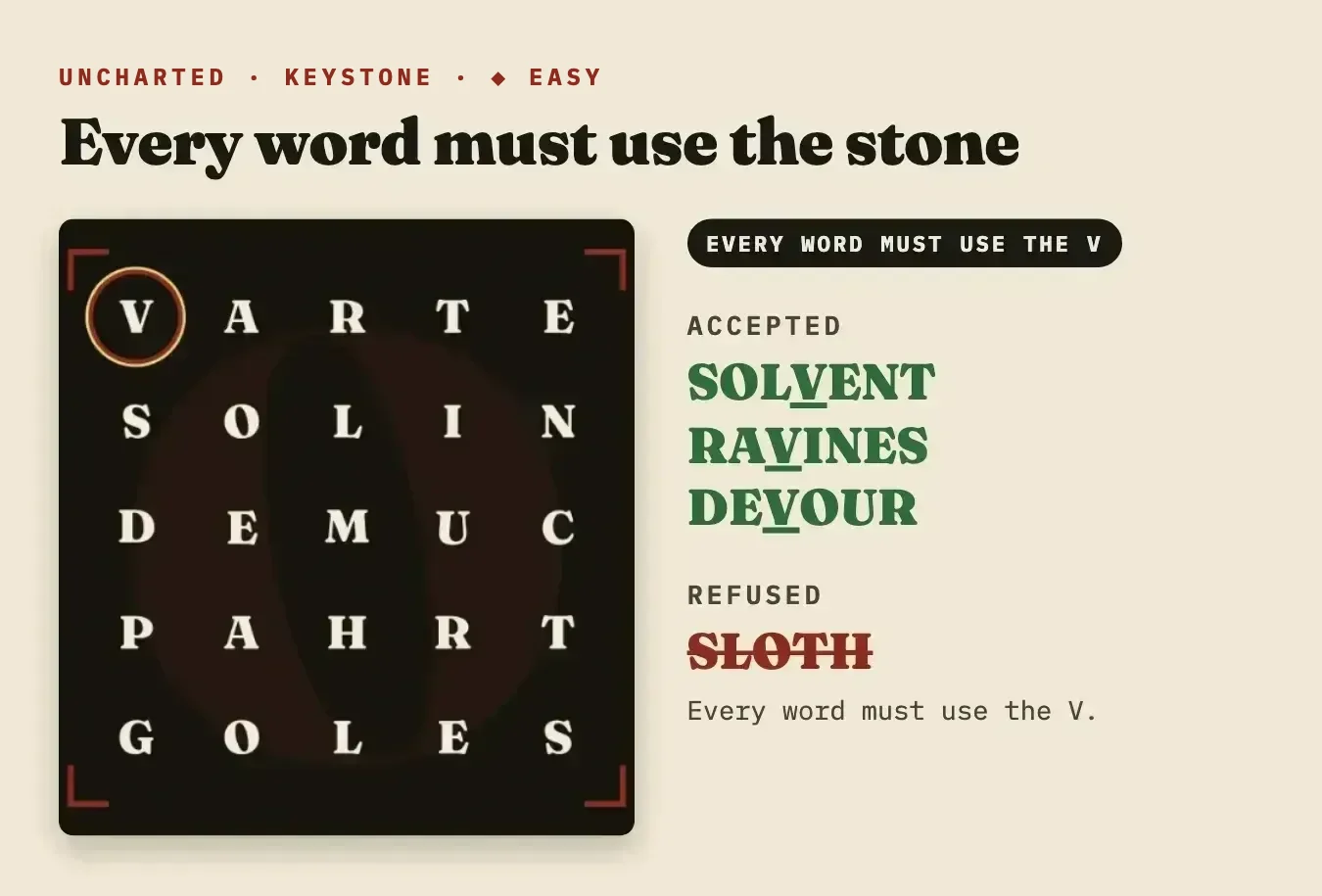
The easiest of the six. The rule never changes, and the stone is the scarcest letter on the board that still makes at least 80 words, so it's usually a V, a K or something like it. Words through a rare letter tend to be rare words, so they score as well as anything else you'd play.
The one catch: every word anyone plays through the stone is gone for the rest of the game, so the easy stone words run out first. Keep a list.
One tap opens a room with Keystone on. Read the Keystone guide for the strategy.
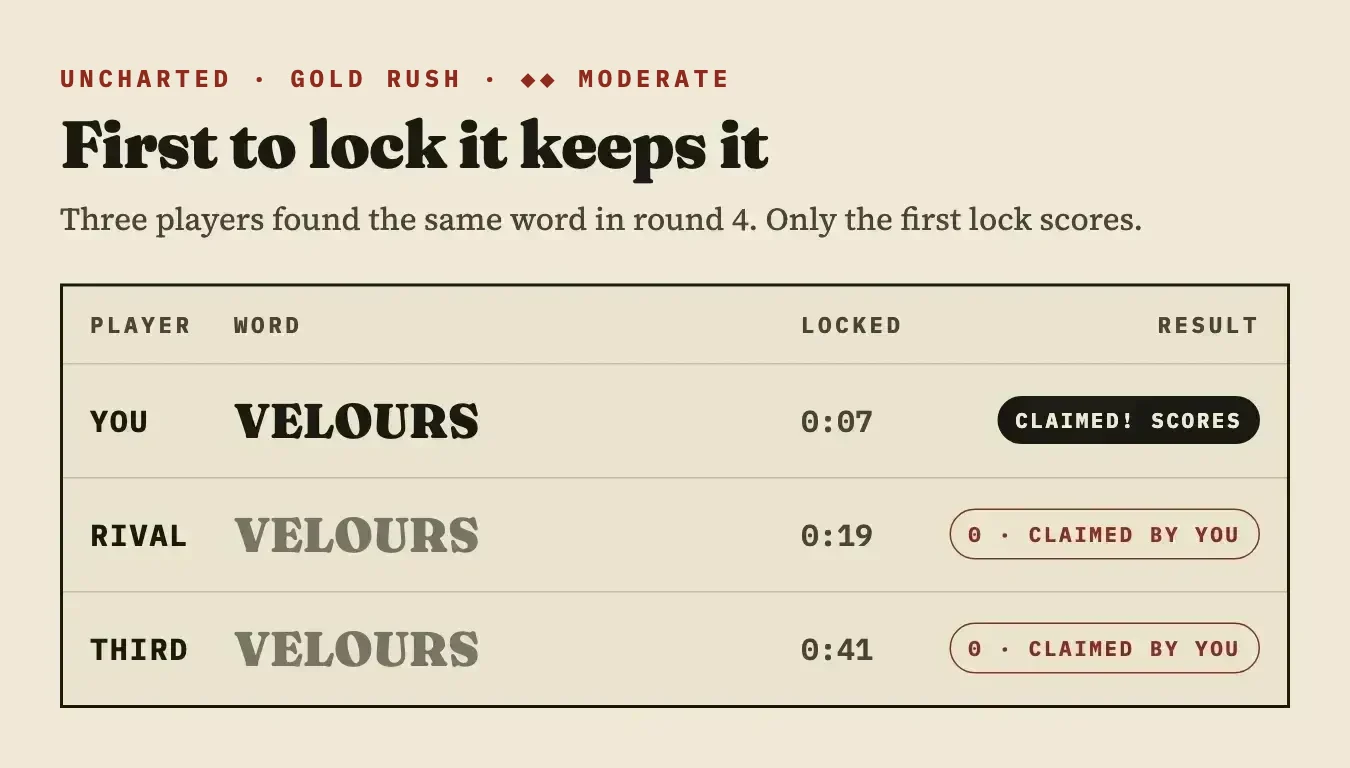
Moderate. In ordinary games two players lock the same word in the same round almost never, so it only bites on the words everyone can see. Gold Rush makes those a race.
Rarity isn't enough on its own any more. On the words everyone can see, you're racing the whole room, and a second late means a real word scores zero. No other rule can do that to a word the game accepts.
So every round starts with a decision: race for the obvious best word, or spend the time hunting one nobody else will find. Guess wrong either way and the round gets away from you.
One tap opens a room with Gold Rush on. Read the Gold Rush guide for the strategy.
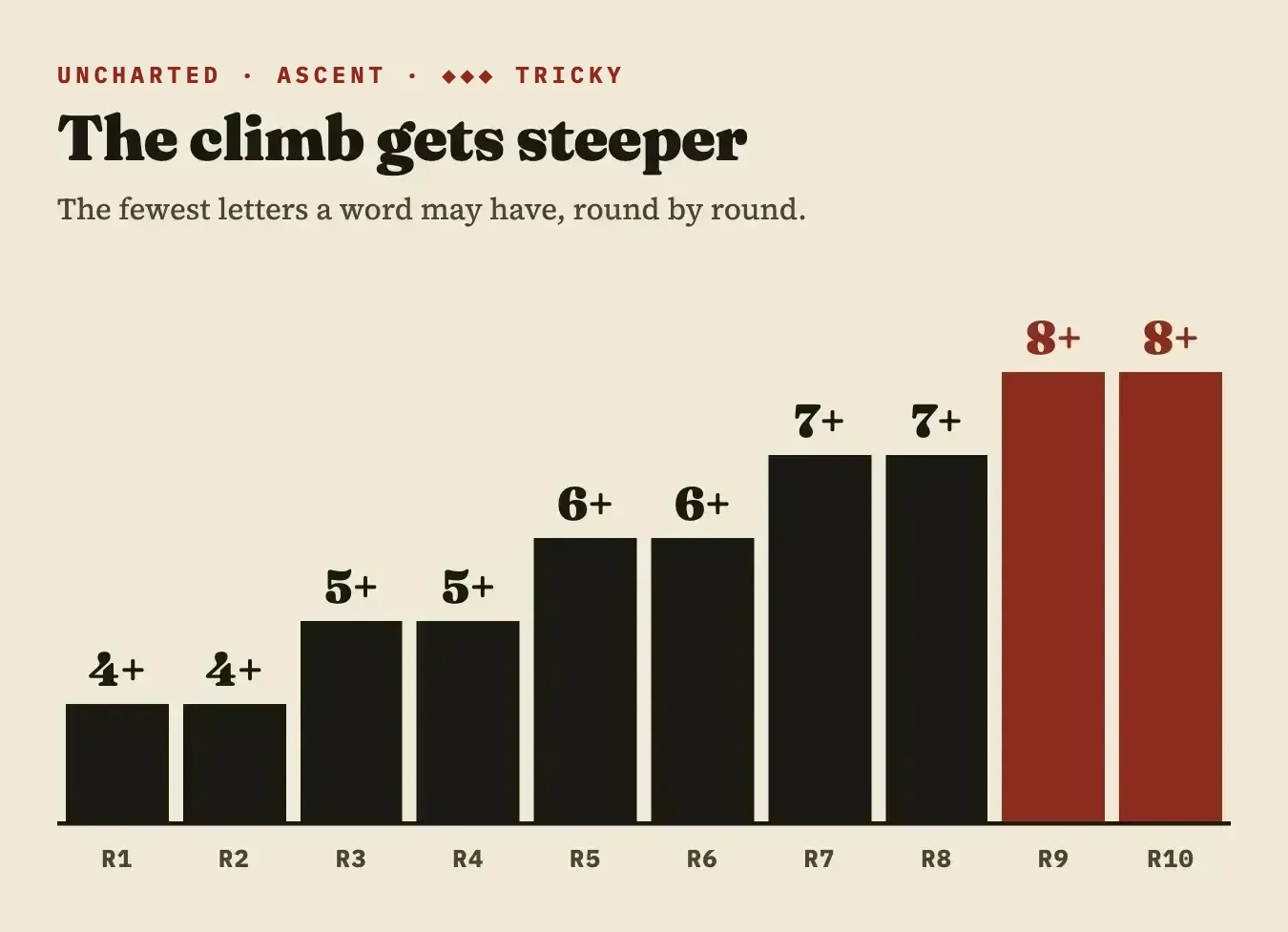
The rule gets harder while you play. Four letters is easy; by rounds 9 and 10 you need eight, and long words are the scarcest thing on any board.
The trap is spending them early. A long word played in round 2 scores the same as it would in round 9, and in round 9 you may have nothing left that's long enough. It's a ten-round plan, not ten separate rounds.
One tap opens a room with Ascent on. Read the Ascent guide for the strategy.
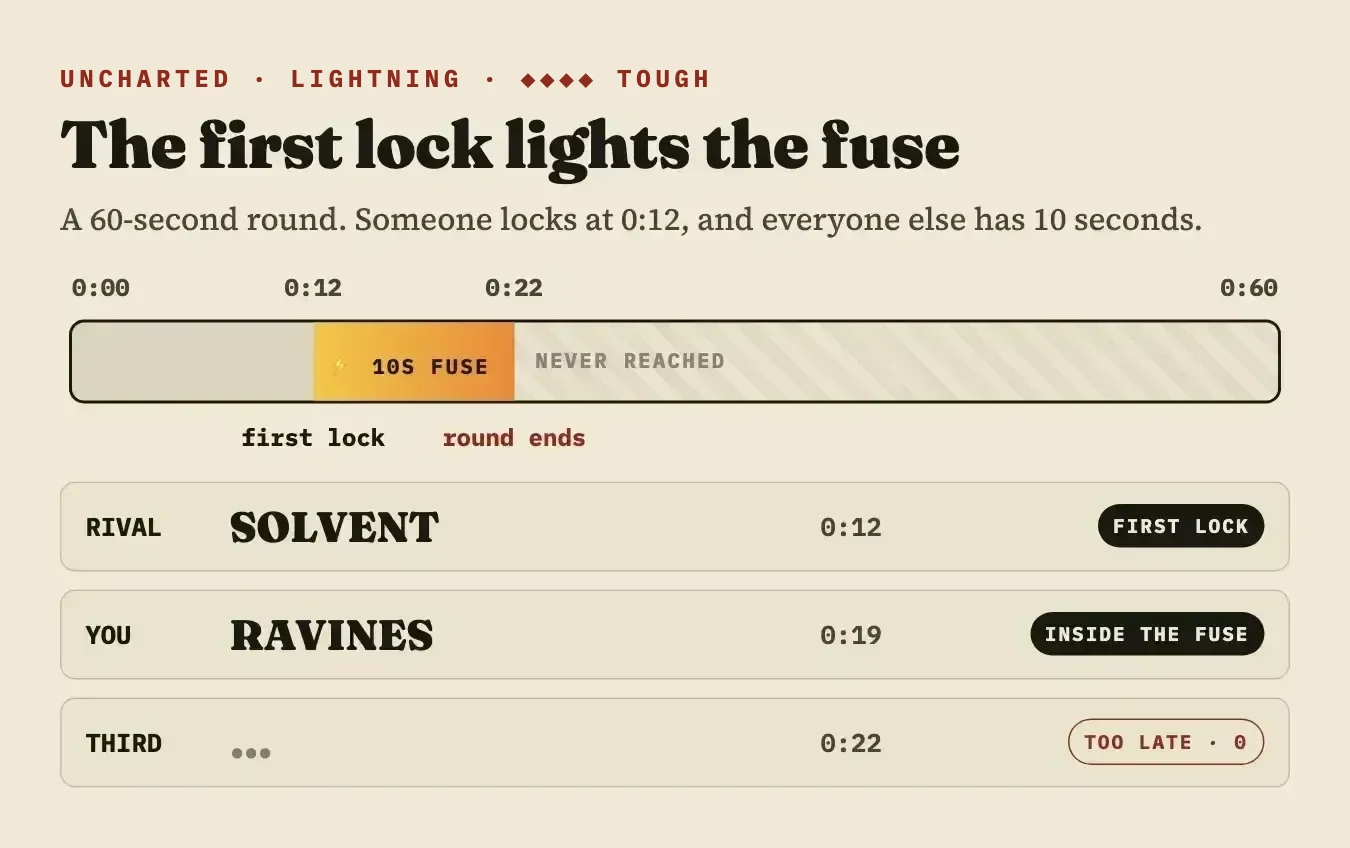
You never know how long you have. One fast player can take fifty seconds off everyone's clock, and an empty hand when the fuse runs out scores zero.
So every round is a standoff: lock early and put the room on a ten-second clock, or hold out for a rarer word and risk someone else lighting the fuse first. A quick lock only pays if the word is good enough to win.
One tap opens a room with Lightning on. Read the Lightning guide for the strategy.
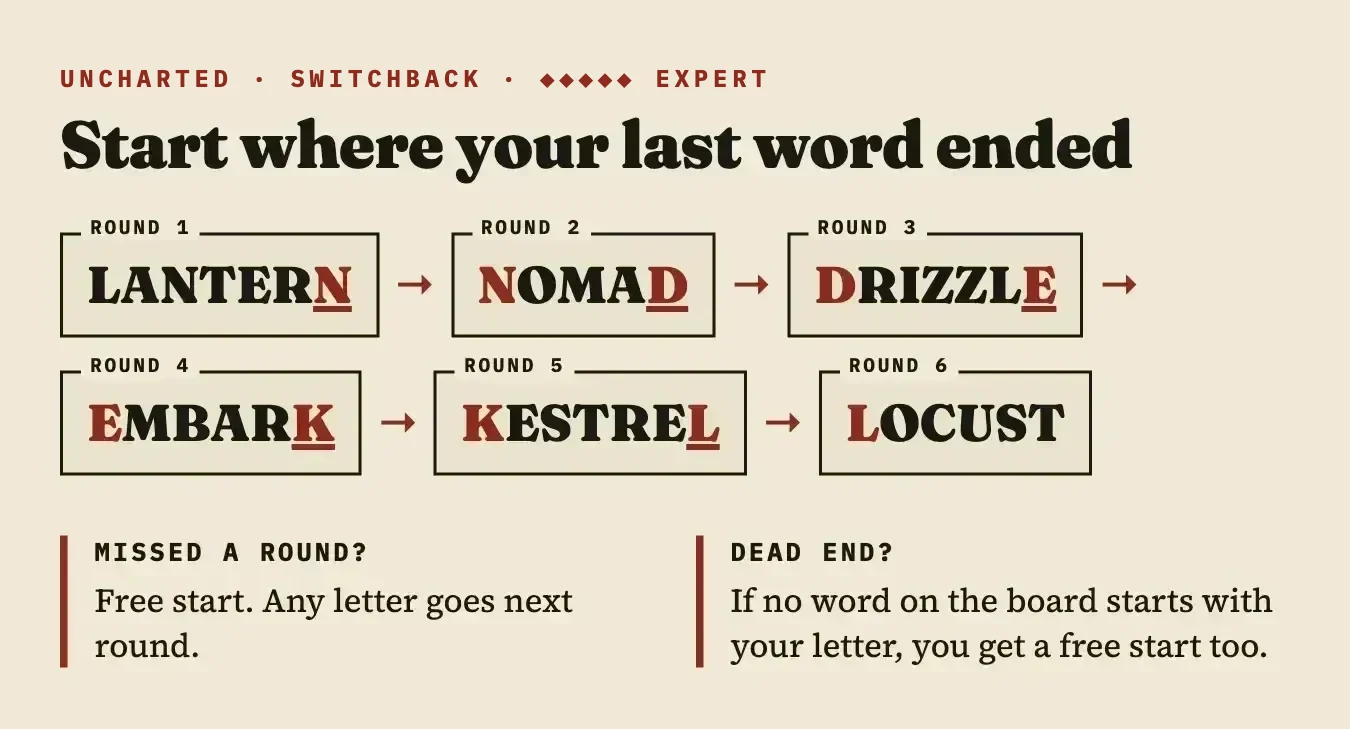
Every lock decides where your next word has to start. A great word that ends on an awkward letter can leave you with nothing good next round.
So you're always thinking one move ahead, like a chess player: is this the best word, and is it the best word to end on? Missing a round or hitting a dead end gives you a free start, but it costs you a round to get it.
One tap opens a room with Switchback on. Read the Switchback guide for the strategy.
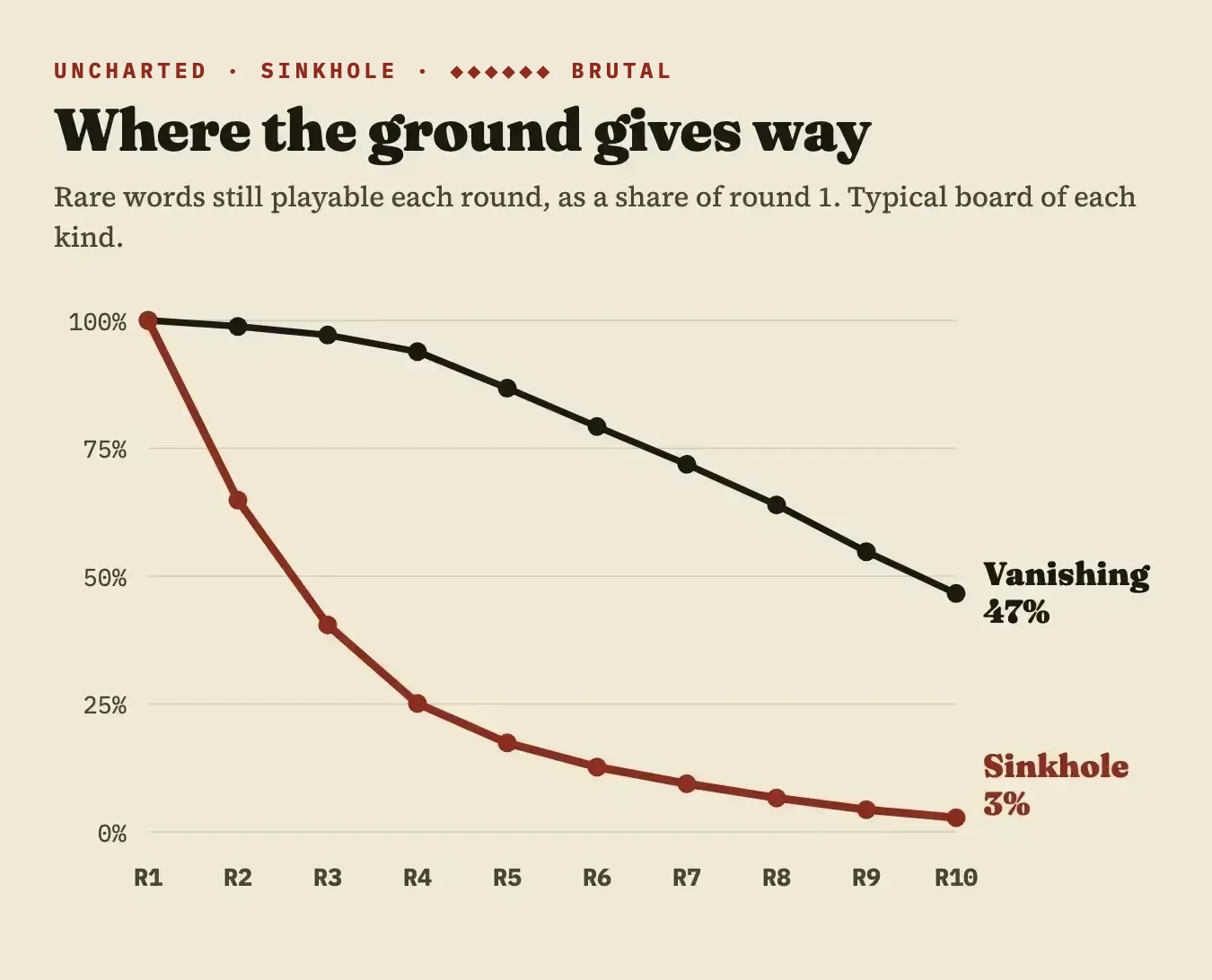
The board is working against you. A letter sinks every round, and it's the one your rarest words depend on.
On a typical Sinkhole board only about 3 in 100 of the rare words are still playable by round 10, so a word saved for later is usually a word lost. Waiting, the safe habit everywhere else, is the mistake here.
One tap opens a room on a Sinkhole board. Read the Sinkhole guide for the strategy.
Fair before fun
Changing the rules of a competitive game is easy to do badly, so we set ourselves a few lines we wouldn't cross.
Every rule is checked by the server, the same way for every player. If a word breaks the rule it's refused, and that costs you a second, never points. The house players who fill out a room are held to exactly the same check, so they can't play a word you'd be refused.
Sinkhole was the hardest to get right. A board built to take your best letters could easily take everything, and early versions did, draining boards down to a hundred-odd words. The version you'll play is planned so that even in round 10 it still carries at least 300 words, at least 8 of them rare. It's mean on purpose. It isn't empty.
And none of it touches your Live rating. Uncharted games are for trying something new, and I didn't want anyone avoiding them to protect a number. They also stay out of Outlier Live Daily, the shared game every evening, which keeps its own rotation.
Why bother
I could keep OUTLIER exactly as it is, and plenty of people would keep playing. But the reason I started this was a feeling I had about word games: that they could be more social, more competitive and a lot more surprising than they usually are. Live rooms, rarity scoring, board types, the stats you won't find anywhere else; each was a step toward that. Uncharted is the next one.
The same letters you've played a thousand times, with the edges of the map moved.
Michael Szerencsy
A lot of what's in OUTLIER today exists because players told us something. Missing words, rules that felt off, features they wanted. Uncharted will be the same. Some of these rules will become favourites and some will need work, and the only way I'll know which is if you play them and tell me.
Try one
The first time you meet each rule, a card explains it before round 1, so you can walk in cold. Host a game and pick one under Uncharted, or let one turn up in an open room. Each one has its own guide if you want the strategy first.
Pick a rule under Uncharted, then send friends the link.
I'll see you in the rooms.