
By Michael Szerencsy
Most game scores go up because you played. A Trivia rating does not. It is a measure of how you do against the people who faced the exact same questions, so it can sit still through a hundred games and then move a long way in ten. This piece is the whole thing: what the number means, why it behaves the way it does, when it settles, what the titles ask for, how the twenty topic ratings work, and the short list of things that genuinely raise it. If you want the game itself first, start with the complete Outlier Trivia guide and come back here.
What the rating actually measures
Every question you answer has been answered by other people. The rating starts there, one question at a time: for each question you were asked, it looks at everyone else who was asked the same one and works out what share of them you beat. Points carry both rightness and speed, so beating somebody means you were right where they were wrong, or right and quicker.
That gives you a share, question by question. Beat everyone on a question and the share is one. Beat nobody and it is zero. Land in the middle and it is a half. Your rating is built from the average of those shares across everything you have ever answered, Today's Ten and Quick 10 alike, and then placed on a scale where 1,200 is the middle of the field.
Two consequences fall straight out of that. The first is that the rating never asks whether a question was hard, because it does not need to: if everyone found it hard, beating them on it is worth a lot, and if everyone breezed it, beating them is worth almost nothing. The second is that you cannot inflate it by choosing gentle games. There is no such thing as a gentle comparison.
The algebra, once, for the people who want it
You do not need this part to play well, and everything above is the honest version in plain words. But the shape of it is simple enough to write down, so here it is and then we will not mention it again.
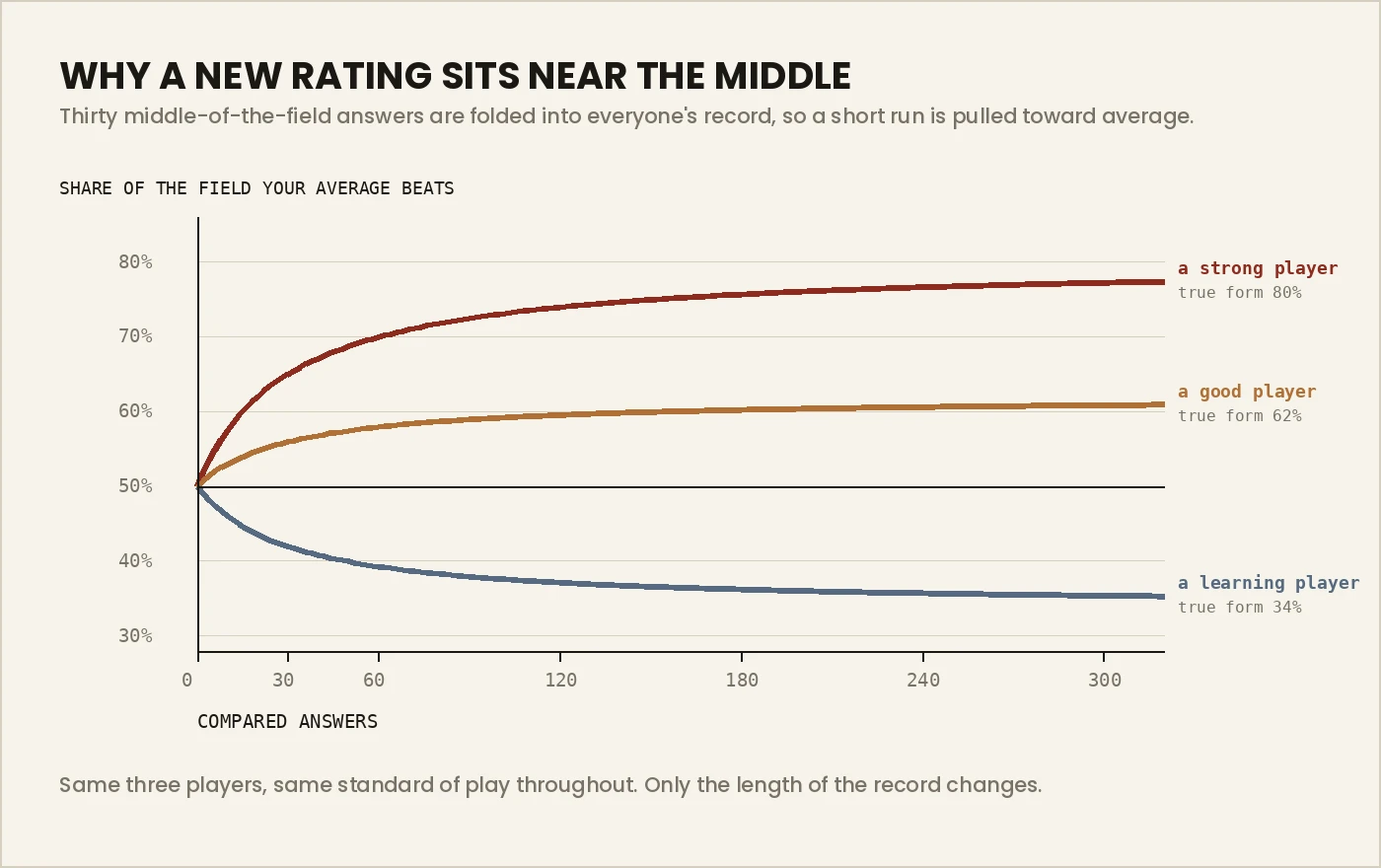
The 30 halves are the interesting part. They are a steadying weight, thirty imaginary answers that were exactly average, folded into everyone's record. With ten answers behind you they dominate and your form sits close to the middle whatever you did. With three hundred behind you they barely register. Per topic the same weight is used, set to 10 rather than 30, because a topic record is necessarily shorter.
The second line is what turns a share into points. Your form on its own is a number between zero and one and means nothing to a reader, so it is measured against the spread of everybody else's form: sit exactly at the average and you are at 1,200, sit one standard deviation above it and you are at 1,550, two above and you are at 1,900. That is why the ladder is spaced the way it is, and why the top rungs are genuinely rare rather than just high-sounding.
It is an average, not a counter. This is the part that surprises people
Word game scores add up. Streaks add up. A Trivia rating does neither. It is an average of how you compare, so playing another game does not add to it, it folds one more result into it.
Playing more does not raise your rating. Playing better than the field does.
Ten more games at your usual standard leaves you roughly where you were, which is exactly what an average should do. Ten games well above your usual standard move you up. Ten below move you down. A long record does not make the number bigger; it makes the number harder to move, in both directions, because each new answer is a smaller share of the total.
The flip side is the fairest thing about it. A player with forty games and a player with four hundred are on the same scale. Turning up every day is a lovely habit and it will not, on its own, put you above somebody who plays twice a week and answers better.
Your first thirty answers, and why a new rating moves
Under 30 compared answers you do not have a rating yet. You have a record being built. Each game puts roughly eight compared answers on it, so most players cross the line somewhere in their fourth or fifth game, and the first number lands the next time ratings are worked out.
When it does land, it will often look higher or lower than you expected, and then wander over the following week. That is the steadying weight letting go. Early on it is pulling you toward the middle and hiding how good you actually are; later it stops mattering and your real form shows through. Nothing changed about you. The record simply got long enough to trust.
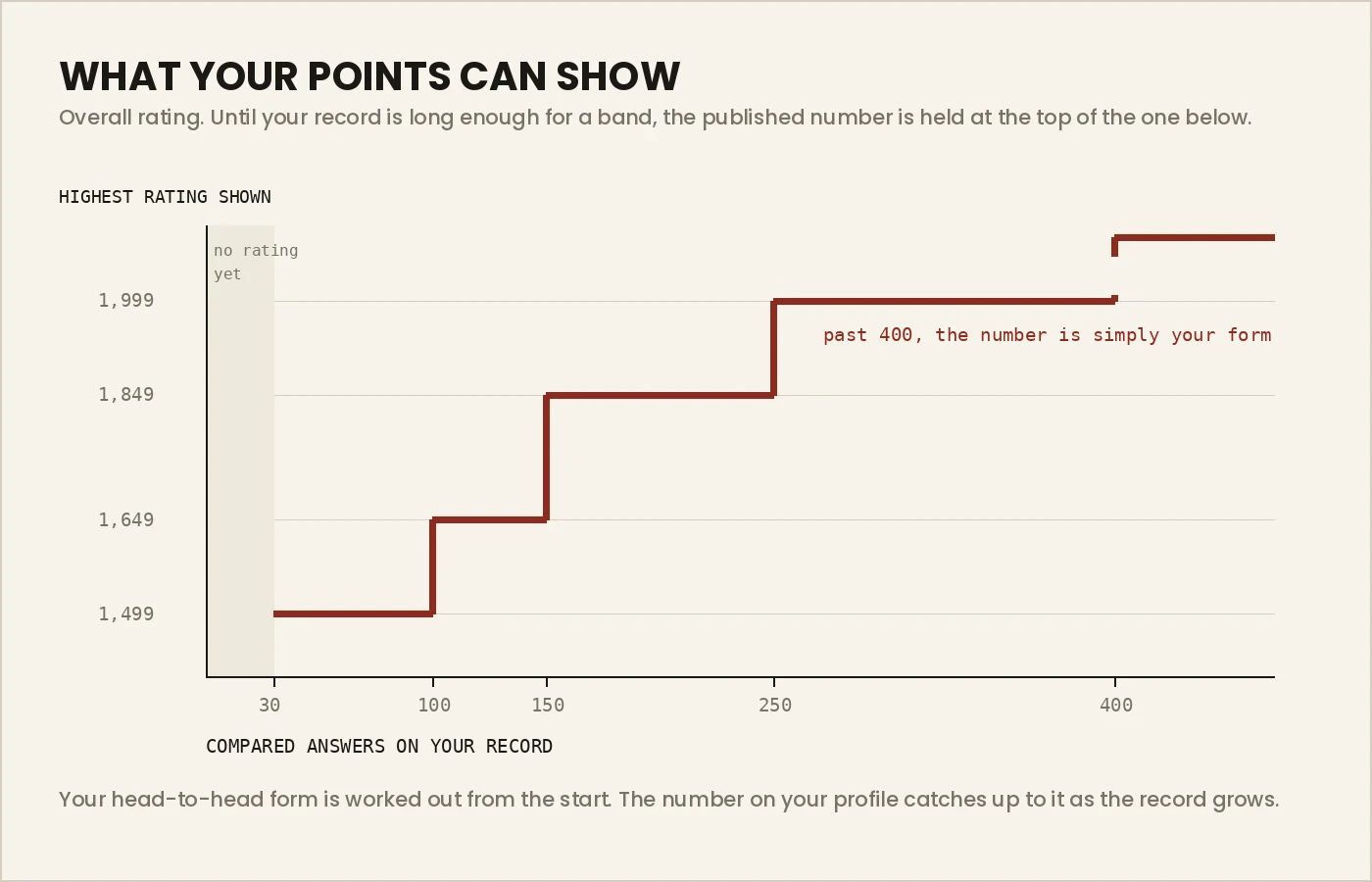
There is a second, deliberate hold on top of that, and it is the reason points and titles never disagree. The number on your profile is capped by the length of your record: below 100 compared answers it will not show above 1,499, below 150 not above 1,649, below 250 not above 1,849, below 400 not above 1,999. Past 400 the cap is gone and the number is simply your form.
The title ladder
Six titles sit on the scale, and each one asks for two things: enough rating points, and a long enough record to believe them.
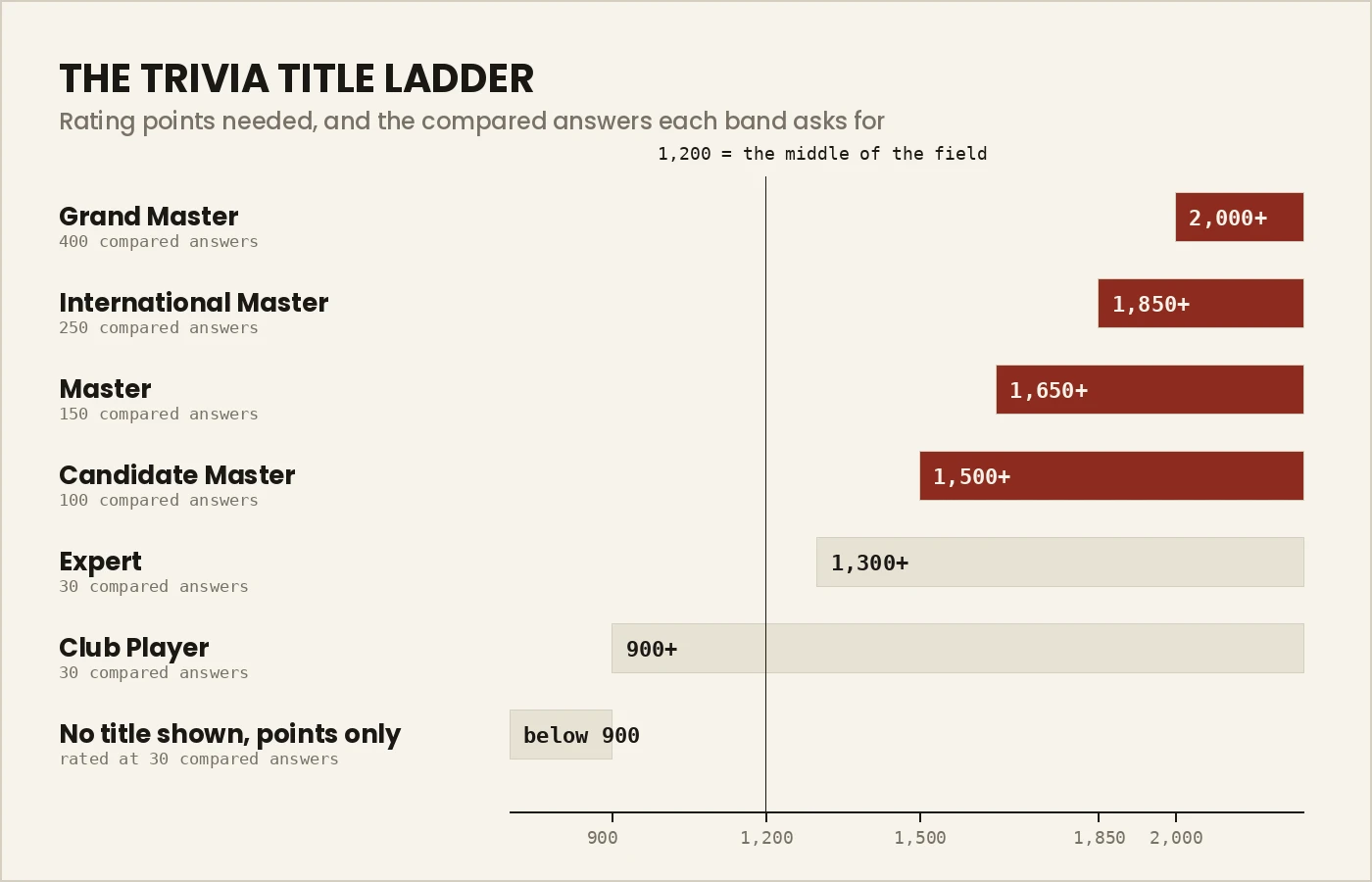
Below Club Player there is no title on screen, only your points. That is on purpose: a rung with a discouraging name on it is worse than no name at all, and the points already tell you where you stand.
The bands were not chosen to sound impressive. They were drawn against the shape of the field so that each one lands near a share of the rated players, with Grand Master near the top one per cent, International Master near the top three, Master near the top ten and Candidate Master near the top twenty. As the field grows those shares drift a little, because the scale follows the field rather than a fixed table.
Titles from Candidate Master up carry a short chip beside your name on the boards. Everything from Club Player up shows in full on your profile.
How to actually raise it
Four things move the number, and they are not the four people assume.
One practical note that follows from all of the above: breadth pays. A player who answers across all twenty topics meets more questions where the field is weak, and those are the profitable ones. A specialist who plays only their best topic spends most of their answers in a crowd of other people who are also good at it.
And one thing that does not help: replaying what you already know. Each numbered Quick 10 game is playable once, so there is no farming a set you have seen. The comparison is always against people who faced the same ten.
Topic ratings: twenty ladders, not one
Alongside your overall rating you carry a rating in each of the twenty topics, worked out exactly the same way but only from your answers in that topic, and measured against the field for that topic alone. Being good at Mythology is a claim about Mythology, so it is compared only with other people answering Mythology.
Topic ratings start much sooner. Ten compared answers in a topic and you are rated there, which is often a single game or two if the deal was kind. The volume each title asks for is smaller in the same proportion: Candidate Master, Master and International Master each need 25 compared answers in the topic, and Grand Master needs 60. The published number is held at 1,499 until 25 and at 1,999 until 60, the same idea as the overall cap.
What is in each of the twenty topics
Since topic ratings are earned topic by topic, it helps to know what you are walking into. Here is the honest range of each one, in summary. No questions, because the questions are the game.
Read that list as a map of where your answers are cheap and where they are expensive. The topics you skim past are usually the ones where the field is thinnest.
Reading a Trivia profile
Every player with a username has a public Trivia profile, and it is the place all of this becomes concrete. Your own is always at /trivia/me.
The distinction worth holding on to: score and rating are two different measurements of you. Average score says how many points you tend to put on the board. Rating says how you did against the people who faced your questions. A player can have a modest average and a strong rating because the games they played happened to be brutal, and the rating is the one that knows that.
Your main OUTLIER profile carries a Trivia card with your title and points that opens the full record, and the profile menu has a switch to hide it if you would rather keep Trivia to yourself.
Send it on
The share row at the top of this piece sends the whole explanation in one link, which is usually what you want when somebody asks why their rating went down after a good week.
Your rating itself is shareable too: your Trivia profile has its own link and its own card, so a friend who opens it sees your title and your points rather than a generic page. Every result, every board and every numbered Game has the same, and a shared Quick 10 result deals the opener the exact same ten questions you faced. That is the only fair kind of challenge in a game built on comparison.