
By Michael Szerencsy
OUTLIER is a daily word game with one strange, addictive twist: you do not win by finding words, you win by finding the words almost nobody else does. Every day the whole world gets the same grid of letters. Most people pull out the obvious words and feel done. OUTLIER quietly rewards the opposite instinct, the odd word in the corner, the one your eye skipped, the find that makes someone say how did you even see that. This is a full overview of what the game is, who it is for, how it works, and why a few minutes a day has turned into a habit people protect.
What OUTLIER actually is
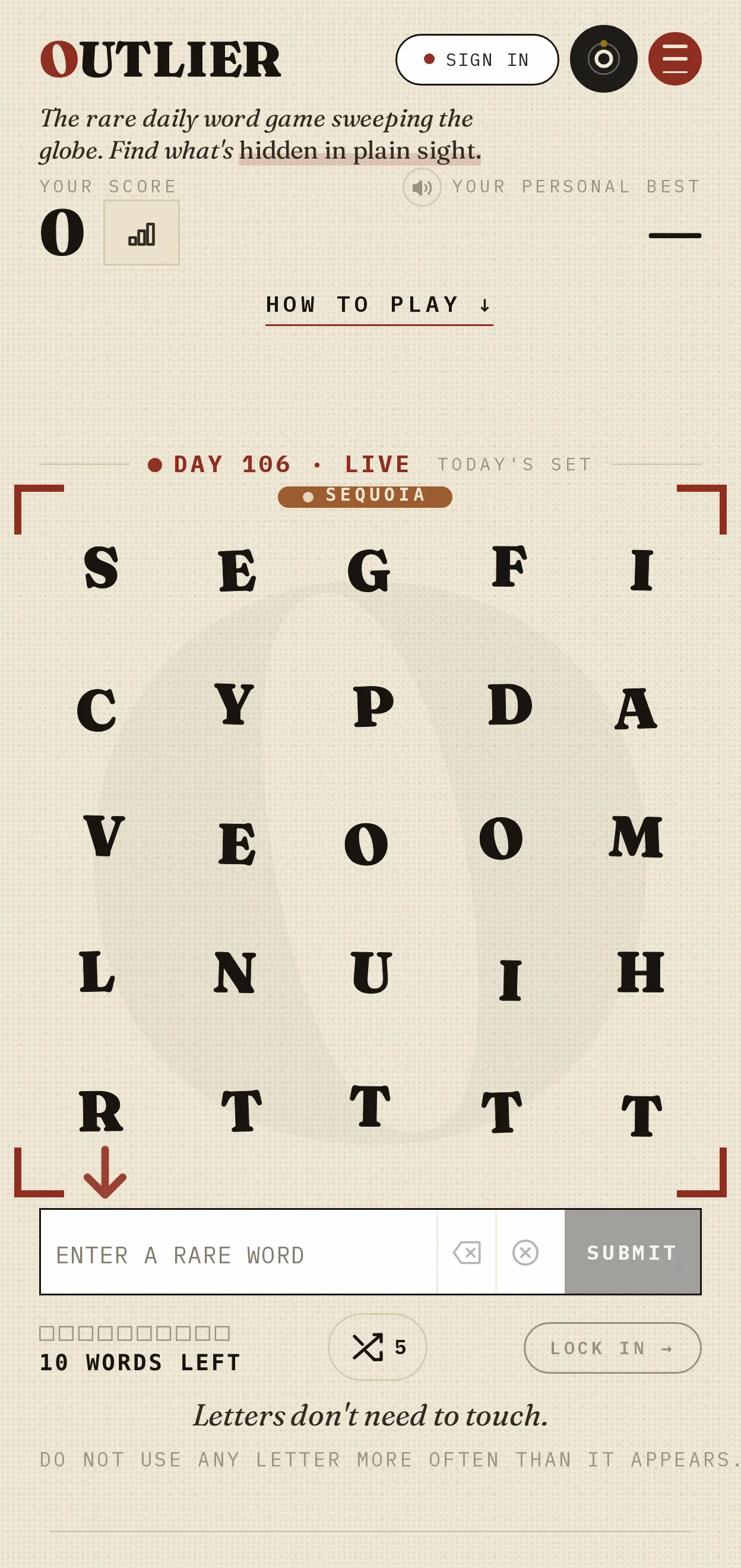
At its simplest, OUTLIER is a once-a-day puzzle. You open today's grid, you get a fixed word grid of letters and ten guesses, and you hunt for real words hidden inside. Each word you find carries a Rarity Score from 0 to 100, set for that board before the day starts by how rare the word is in English and in word games. Common words pay far less. Rare ones pay big. Your job is not to find the most words or the longest words, it is to find the rarest ones the board will give up.
That single design choice changes the entire feel of the game. A long, impressive word that everyone else also found still scores, it just will not move you up the board. A short, ordinary-looking word that almost nobody thought to try is the one that does. The skill is not vocabulary for its own sake, it is the ability to look past the obvious answer to the one hiding behind it.
Everything else is built to support that core loop. There is a worldwide leaderboard so your score means something the moment you finish. There is an all-time leaderboard for the players who show up day after day. There is an archive of past grids you can revisit any time. But the heart of it is always the same: one board, ten guesses, find what the crowd missed.
Who OUTLIER is for
OUTLIER is for the person who liked Wordle but burned through it, who finished the daily puzzle in ninety seconds and wished there were more game underneath. It is for word lovers, crossword solvers, Scrabble players, and anyone who gets a small private thrill from knowing a word other people do not.
It is also for competitive people who do not have time for competitive games. You do not need to schedule anything or commit an evening. You need five minutes and the willingness to be measured against everyone else who played that day. That is a rare combination, a real competition that fits inside a coffee break.
And it is for people who like the social side of a shared puzzle without the friction of a party game. Because everyone in the world plays the identical board, comparing scores is effortless. You can play alongside friends, start an Outlier Group to keep a private leaderboard, or simply drop your result in a group chat and watch someone try to beat it.
How a game works, start to finish
You arrive at the day's board. The letters are the same for every player on earth, which is the foundation of the whole thing: nobody gets an easier draw, so the only variable is how well you see. You have ten guesses to spend.
Each guess is a real word you believe is hiding in the grid. When you find one, it is scored on its Rarity Score and added to your total, and the game shows you where it landed on the rarity scale. The tension comes from your limited guesses. Do you lock in the safe, common word you can see, or spend a guess reaching for something rarer and risk coming up empty?
When your guesses run out or you choose to stop, your day is settled. You get a final score, a daily rank that climbs with the rarity of your best find, and a place on the leaderboard. If you have claimed a handle, the result joins your profile and streak, and tomorrow's board is already waiting. If you want the full rules, the how to play page walks through every detail.
Why it is not a Wordle knockoff
This is the question OUTLIER hears most, and the answer is in the scoring. Wordle and its many clones are convergence games: there is one hidden answer, and every player walks toward the same destination from a slightly different start. Skill is how efficiently you converge. Once you have the word, the puzzle is over and everyone who solved it shares the same result.
OUTLIER is a divergence game. There is no single answer to converge on. The board holds dozens of valid words, and the interesting ones are scattered out at the edges where most players never look. Two people can both finish the same grid and walk away with completely different scores, because they saw different words. The game does not reward reaching the obvious answer, it rewards seeing answers other people cannot.
That difference runs deeper than it sounds. A guess-the-word game like the ones covered in our guide to guess-the-word games tests deduction toward a fixed target. OUTLIER tests something closer to exploration and nerve. It is the same raw material, letters and words, pointed at the opposite goal: not the word everyone will find, but the one almost nobody will.
Why rarity is the whole game
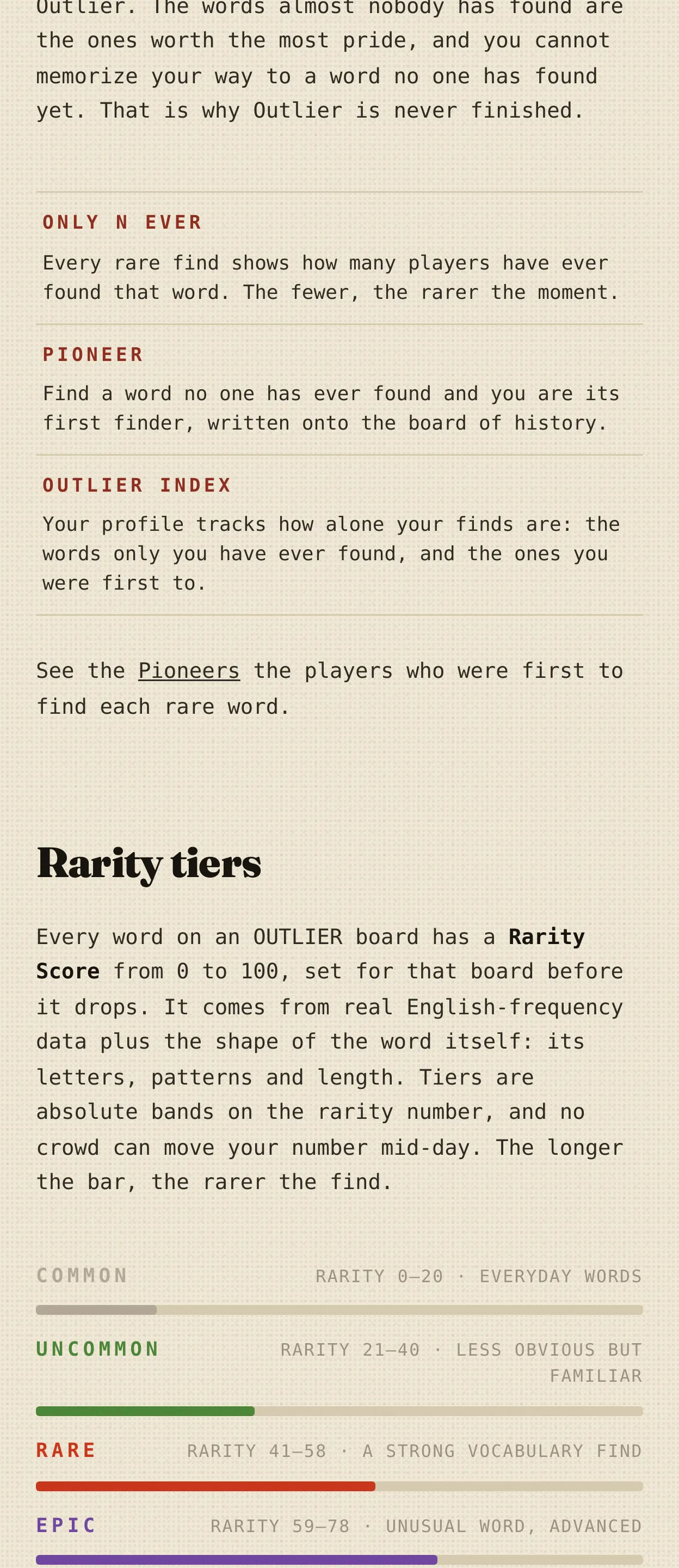
Rarity is what turns a simple word hunt into something with real depth. Because every word on the board has a score baked in before the day starts, the board becomes a landscape of risk and reward. The plain words are safe and cheap. The rare words are valuable and easy to miss. Every guess is a small bet on your own eyes.
It also means the game never quite lets you feel finished. In most daily puzzles, solving it closes the door. In OUTLIER you are never completely sure you found the rarest word the board was hiding, so even after a good run there is a tug of what did I walk past. That open question is what keeps a five-minute game living in your head for the rest of the morning.
If you want to go deeper on what makes a word rare and how to train your eye, the rare words field guide is the place to start. The short version: the rarest usable words are usually not the exotic, unspellable ones. They are short, ordinary-looking words sitting in plain sight, invisible only because nobody looked past the first answer.
The competition is the point
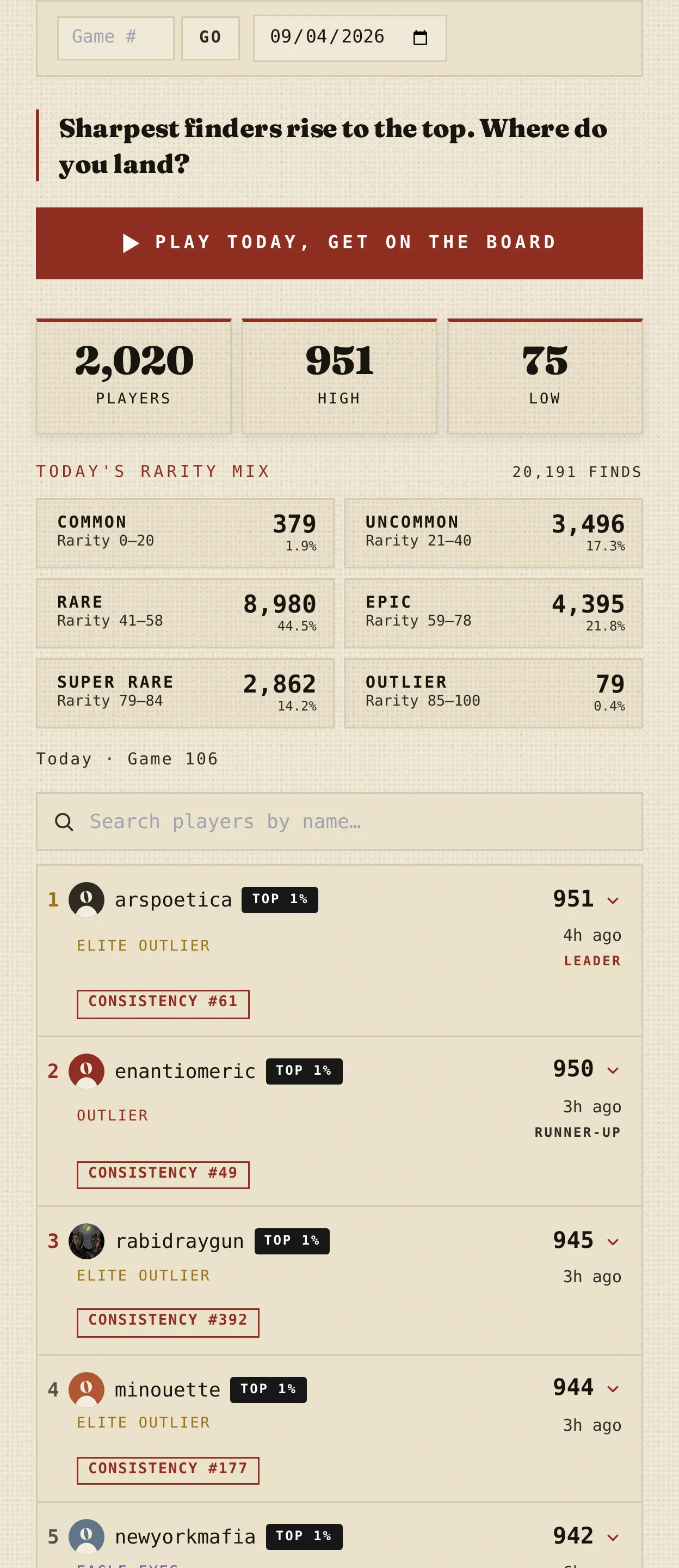
OUTLIER is quietly, genuinely competitive, and that is by design. Every score is measured against every other player who took the same board. Beating the field does not mean knowing more words than everyone, it means seeing one the rest of them missed. That is a different and more satisfying kind of win.
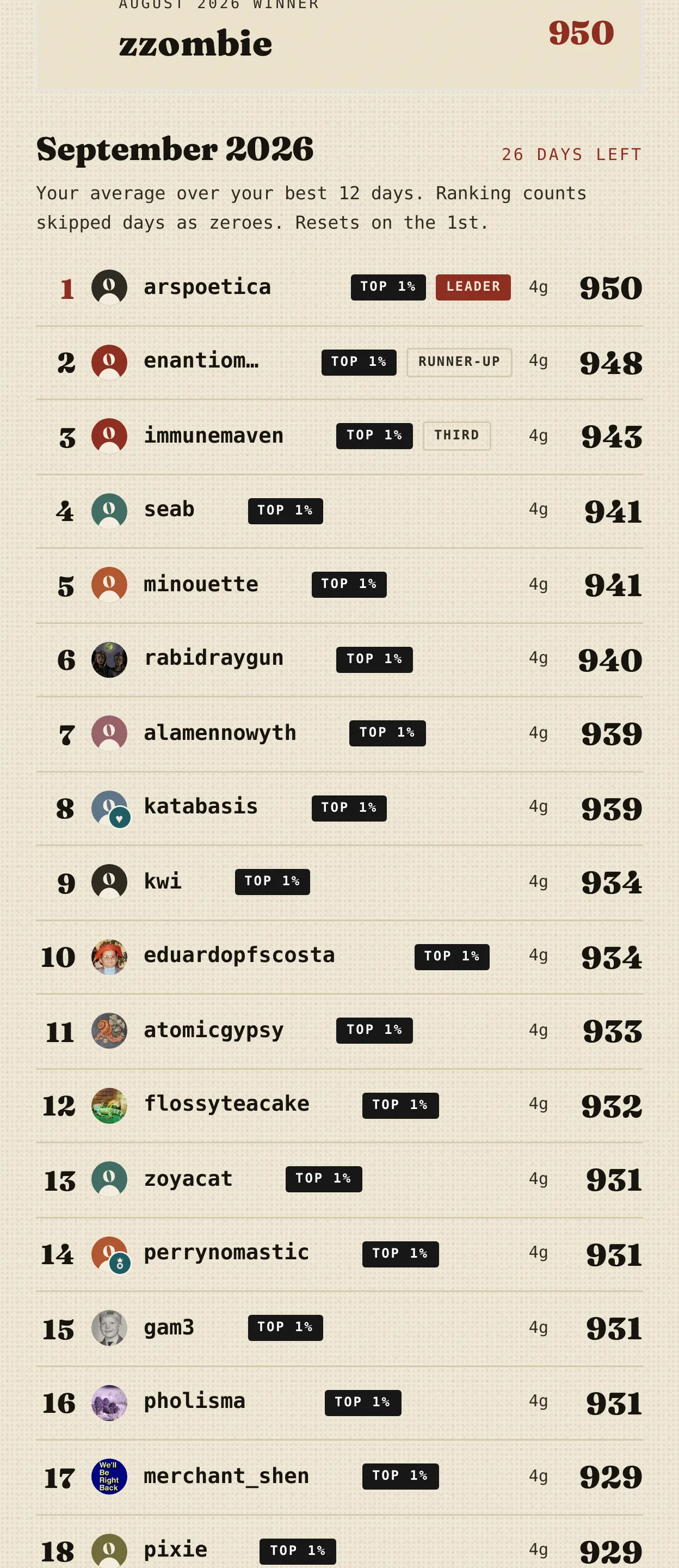
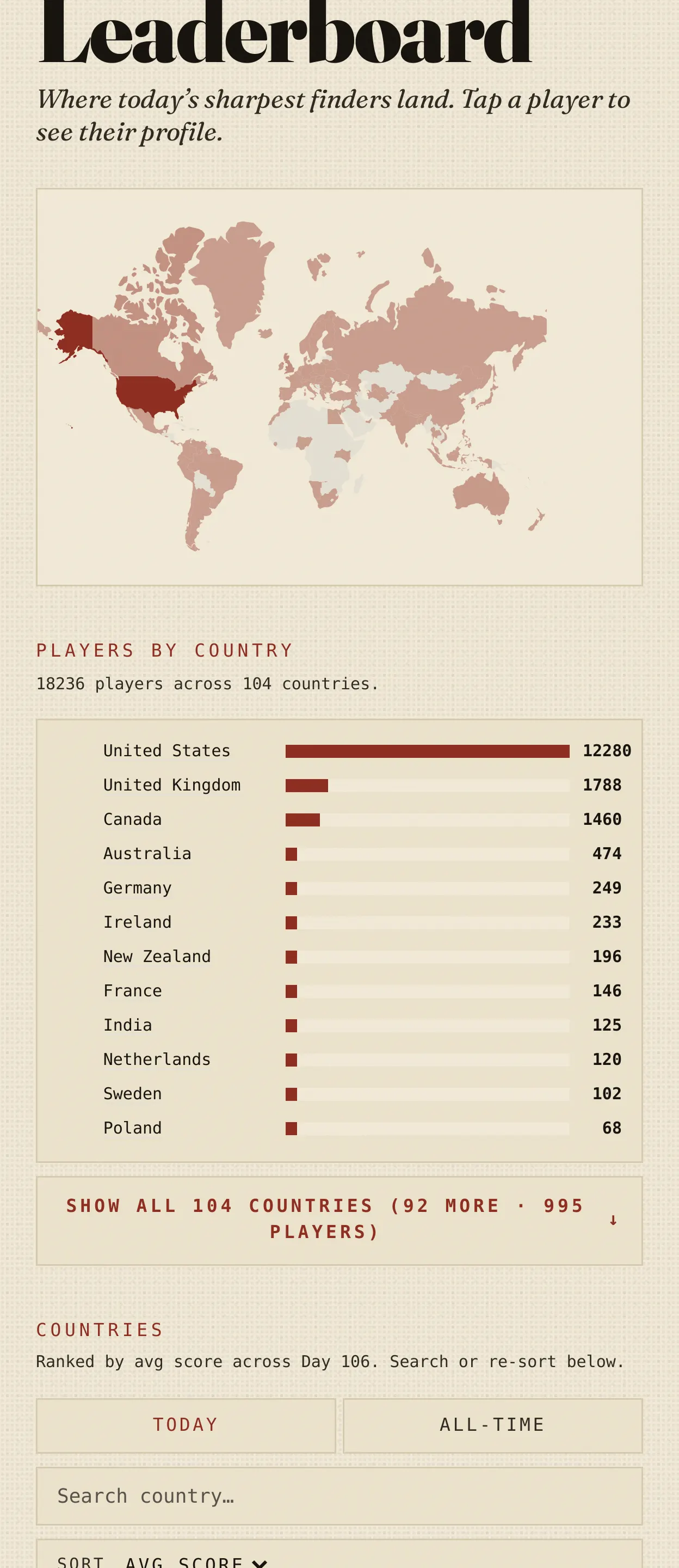
The leaderboards give that competition somewhere to live. The daily leaderboard resets every day, so a great run is always one board away and a bad day never sinks you. The all-time standings reward the grinders who keep showing up. And the world map turns the whole thing global, so your score is not just a number, it is a flag on a board shared with players everywhere.
Because the daily puzzle resets, the competition has a forgiving shape. You cannot fall hopelessly behind. Every single morning, everyone starts even on a brand new board, and the best player is simply whoever sees the most that day. That fresh-start fairness is a big part of why people keep playing instead of giving up.
The social layer, and there is nothing quite like it
Most daily word games are solitary. You play, you get a number, you paste a grid of squares into a group chat, and that is the whole of the social experience. OUTLIER is built the other way round. Because every player on earth gets the identical board, everything social becomes possible without any of the usual friction: there is nothing to schedule, nothing to set up, and no version of the puzzle where somebody got an easier draw. Comparing is instant and it is always fair.
That single fact is what the rest of the game is built on top of, and it is the part people do not expect. There is a following graph, a head to head record against everyone you have ever played, private group boards, real time multiplayer, and a live view of the entire world mid-game. Not one of those would work in a game where players get different puzzles.
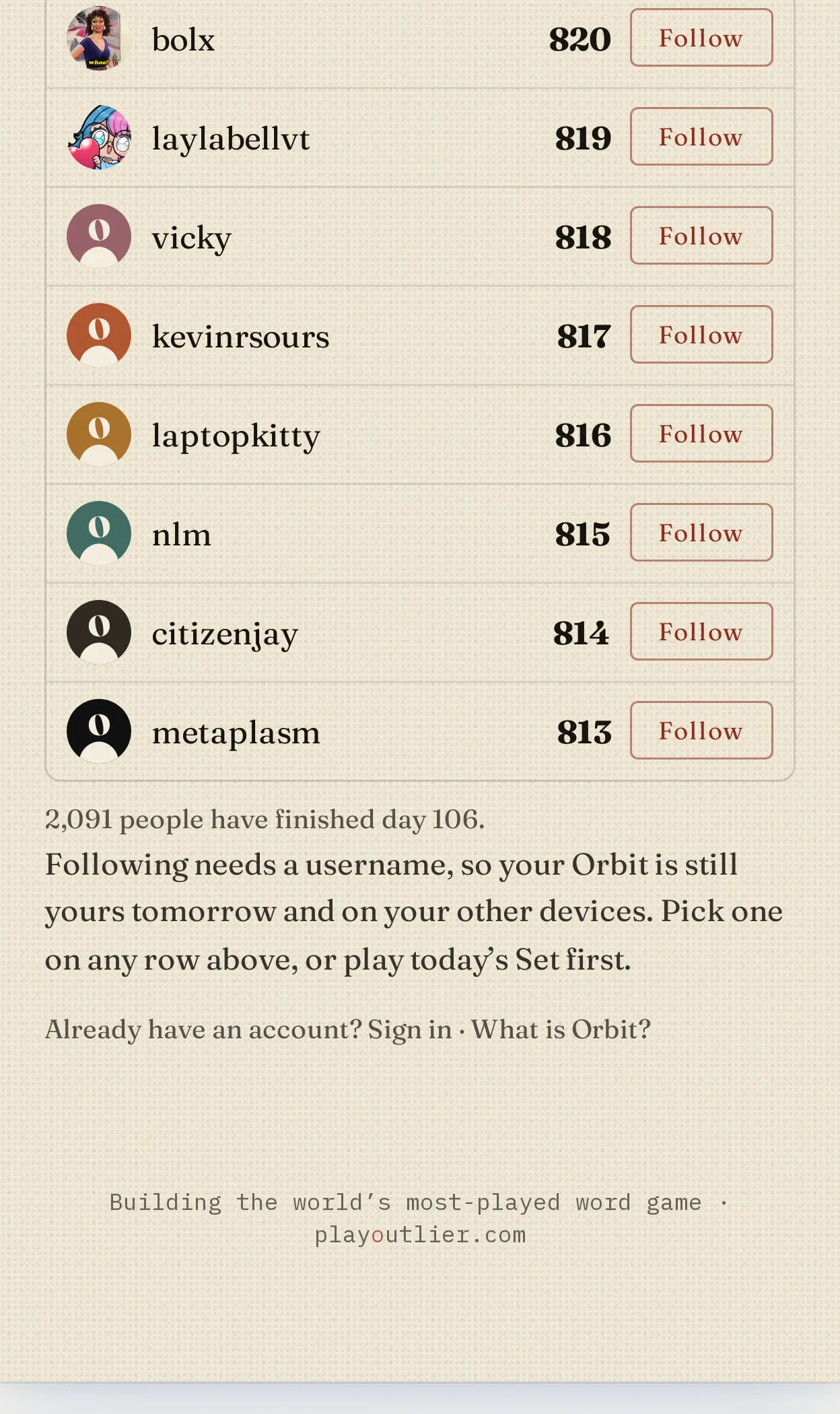
Your Orbit is the following graph. Follow anyone and they stay on your board tomorrow and every day after, ranked against you on today's Set. It is a leaderboard the size of your actual social circle, which turns out to matter far more than being ranked seven thousandth in the world.
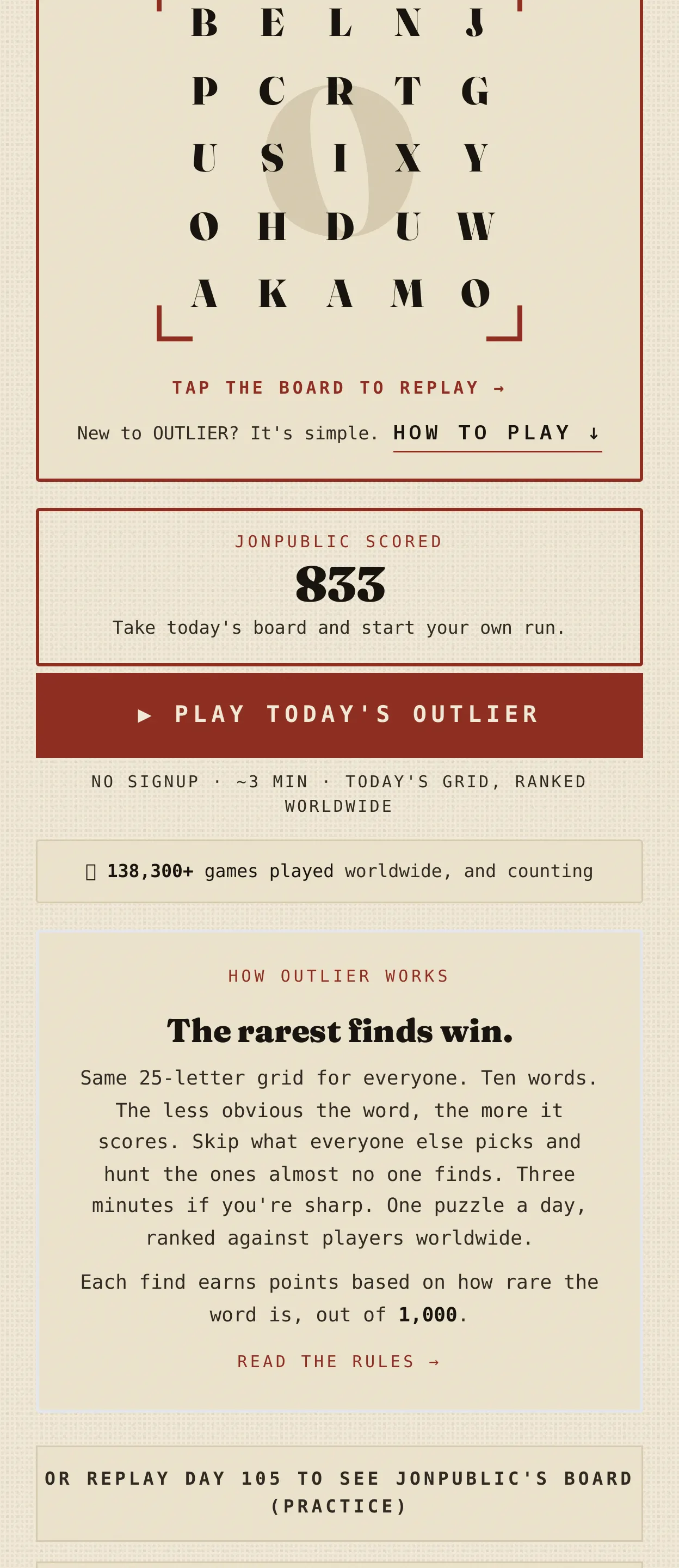
Challenges are the direct version. Send someone your board and they play the same grid you did, and the result becomes a permanent head to head record: every day you both locked a score, counted, with the higher score taking the day. It is the most common way people drag a friend into the game, because a challenge link is a dare with a scoreboard attached.
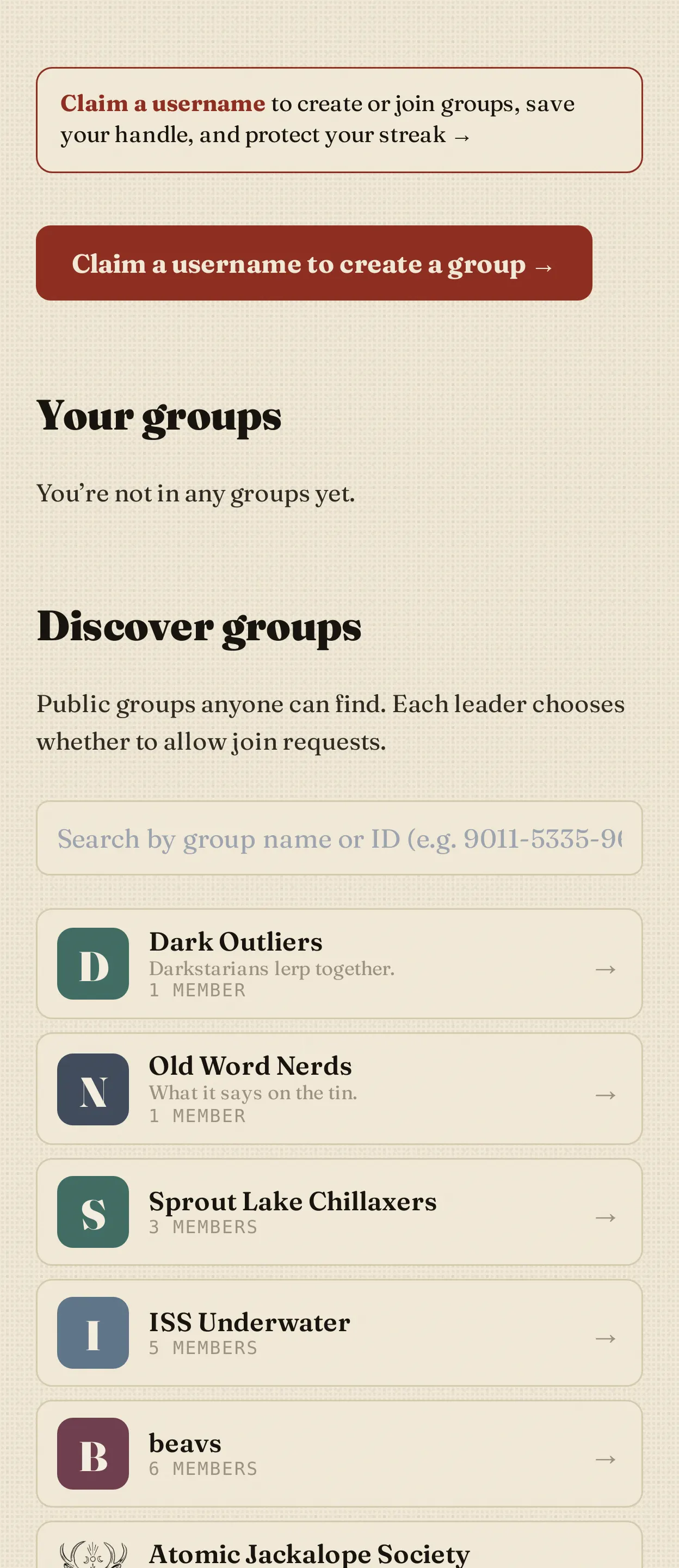
Groups are the private version. An Outlier Group is a leaderboard for a family, an office, a book club or a group chat, with its own daily board and its own arguments. Public groups anyone can find are listed too, so you can join a set of strangers who take it as seriously as you do.
OUTLIER LIVE: the same hunt, in real time
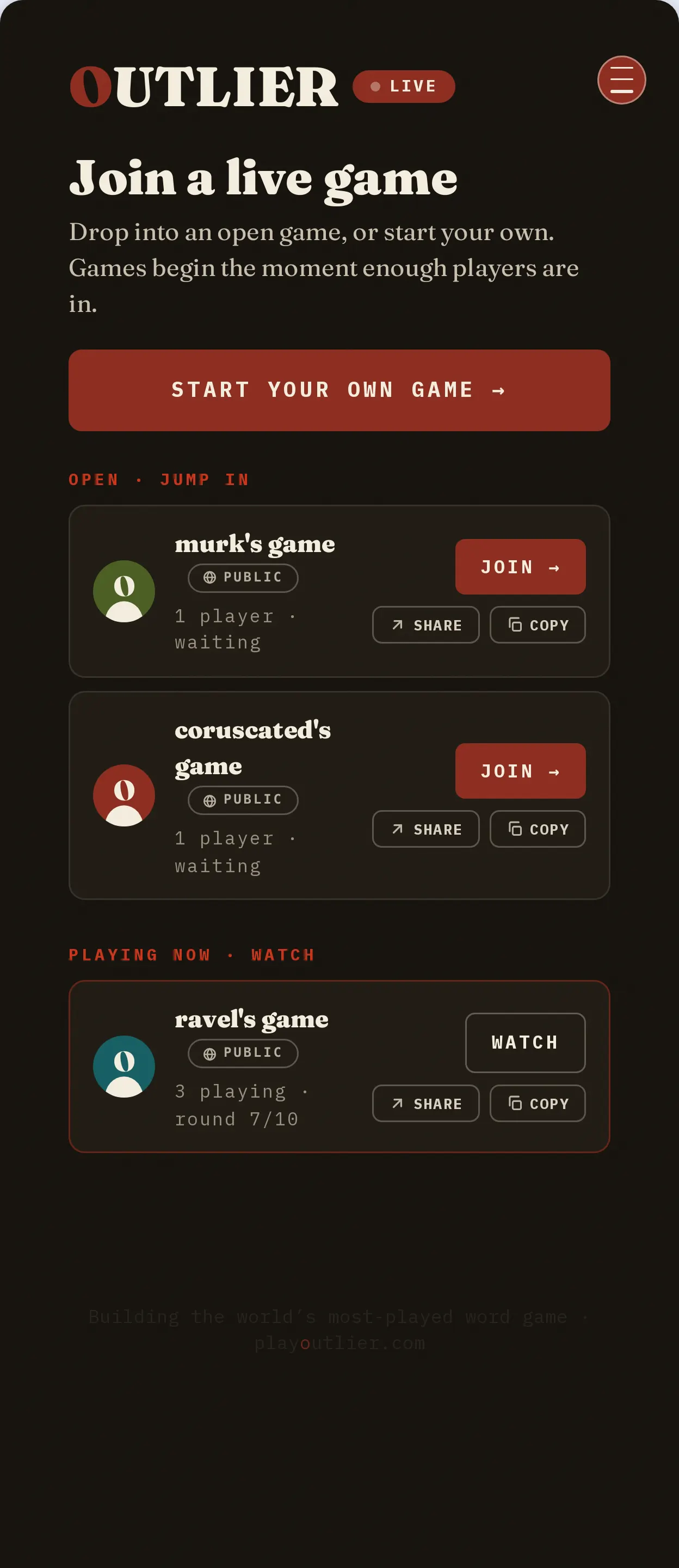
The daily board is a solo ritual you can compare afterwards. OUTLIER LIVE is the opposite: everyone in the room is on the same grid at the same moment, with a clock running. Ten rounds, one word locked per round, and the rarest word takes it. You can see your word is hidden until the buzzer, so nobody can shadow your thinking.
Games start the moment enough players are in, so there is nothing to arrange. Open the lobby, drop into a game somebody else started, or start your own and send the link. You can also just watch: any game in progress can be spectated, which is the fastest way to understand what the game feels like at speed.
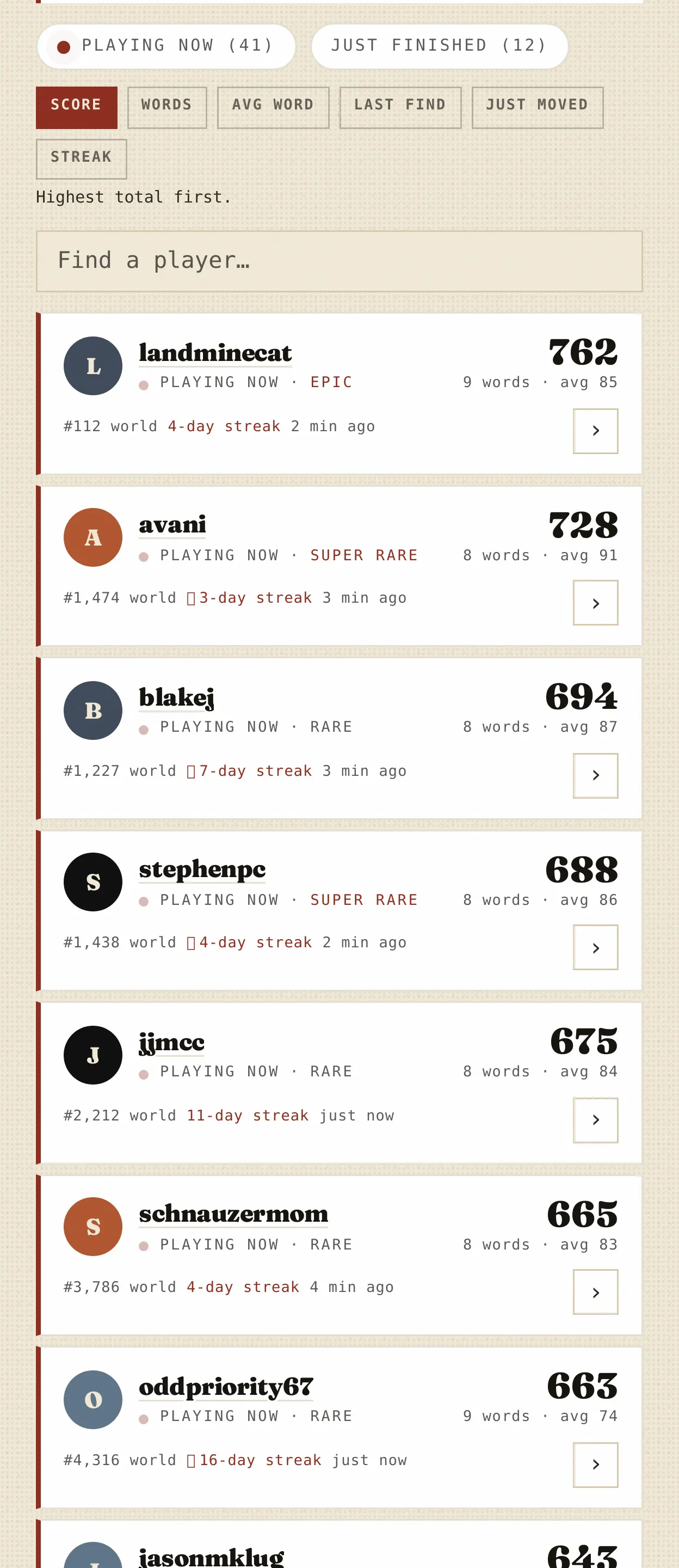
Watch the whole world play, right now
Because everybody is on the same board on the same day, OUTLIER can show you something no other word game can: the entire world mid-game. Playing Now is a live view of every player currently on today's grid, with their score climbing as they find words. It updates on its own. You can open any of them and watch a stranger in another country work the same twenty five letters you are stuck on.
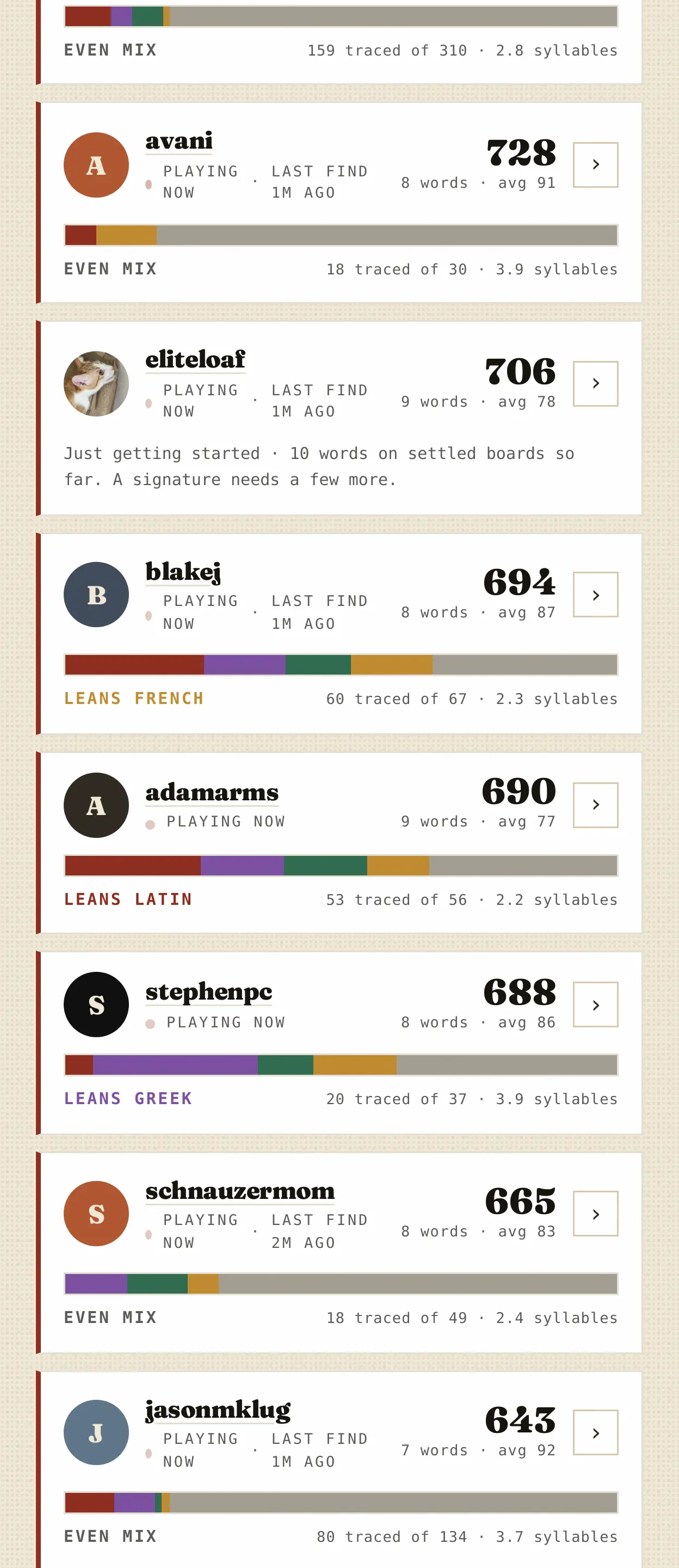
Live Word DNA is the same live cast seen through the words people have found over their whole history: which languages their vocabulary leans on, how far they reach, how rare their finds run. It is a portrait of how somebody sees a board, built from every board they have ever played.
Your profile is a record of how you see
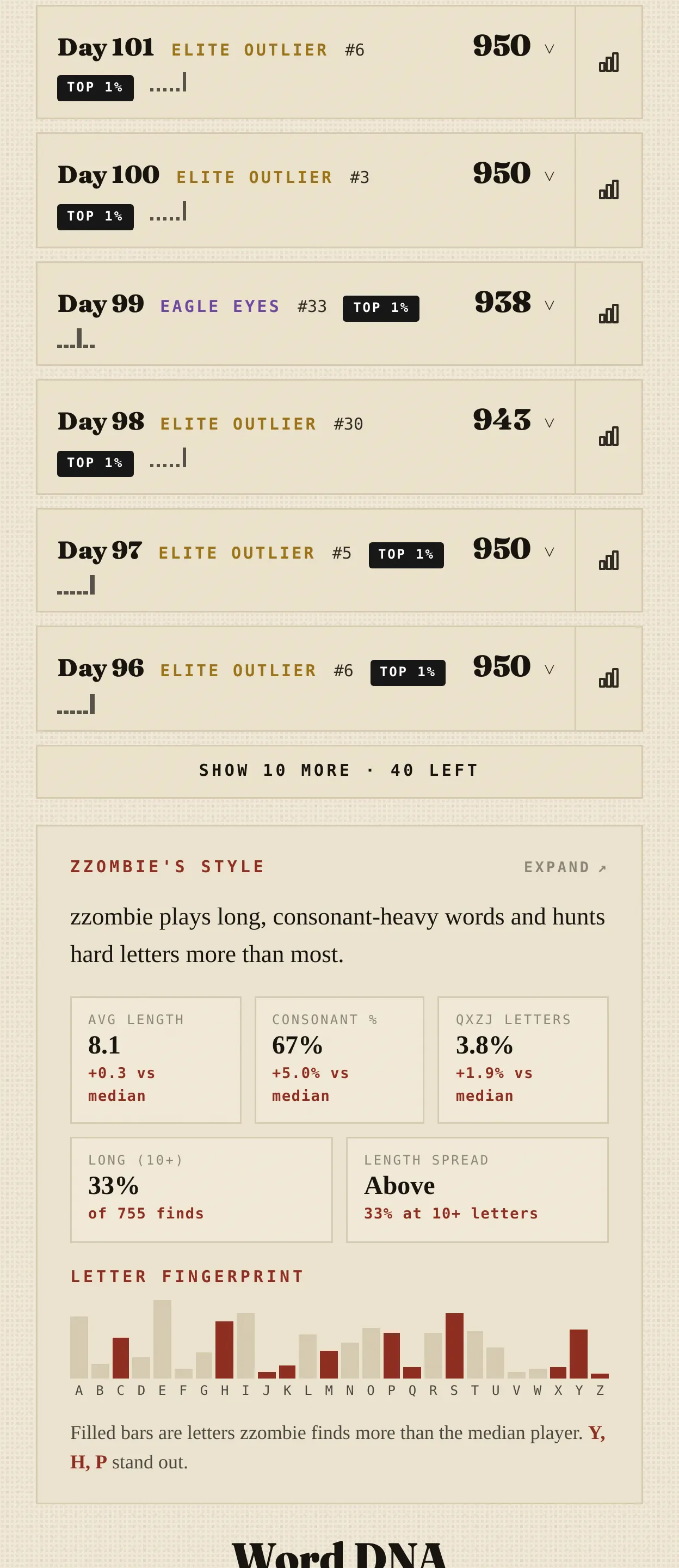
Play a few boards with a handle and a profile builds itself. Not just a score, but a shape: your best day ever, your average, the streak you are protecting, the titles you have earned, where you land in your country and in the world, and the run of every game you have played.
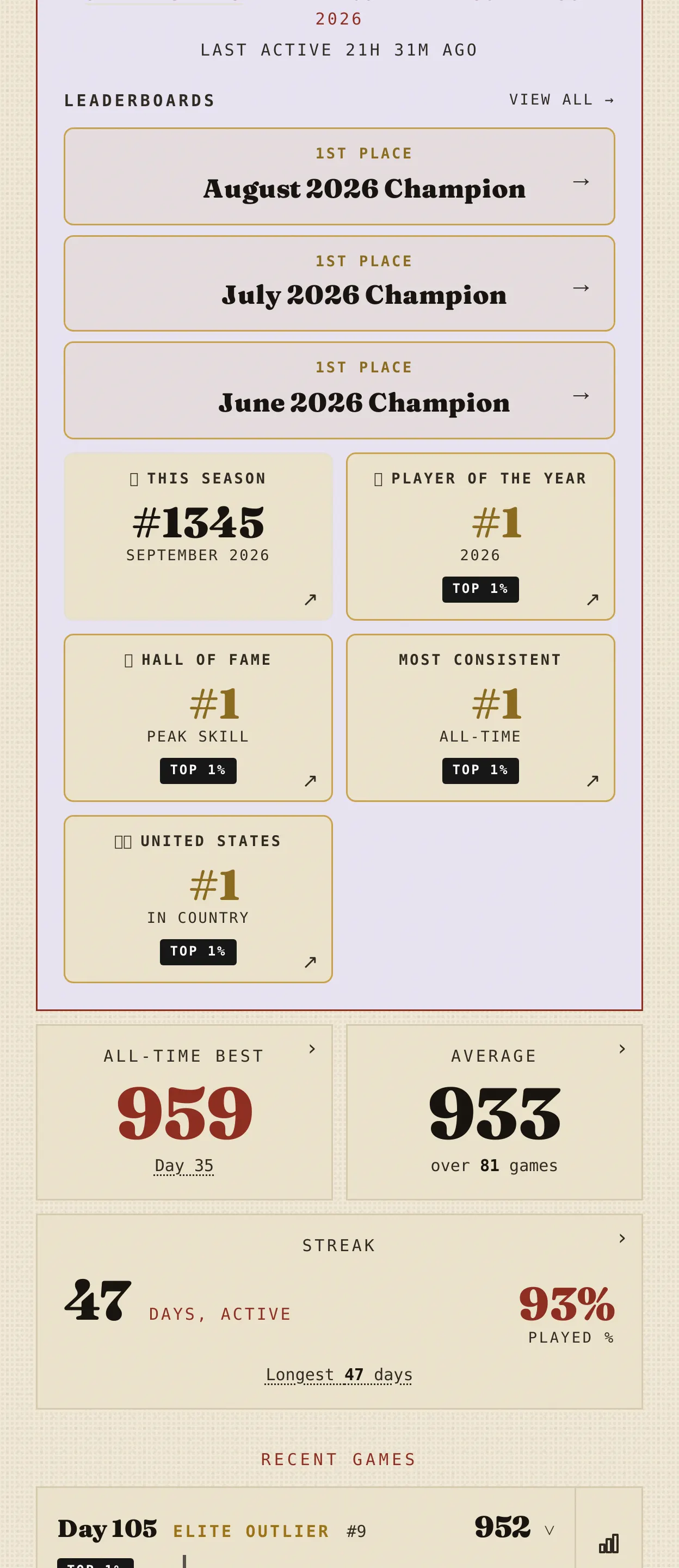
Underneath that sits the part players did not expect to care about: your style. How long your words run, how often you reach for the rarest tiers, which letters you find and which you walk past, and your Word DNA, the languages your vocabulary actually comes from, traced through etymology. It is the game telling you something true about the way your own eye works.
Why people keep coming back
The honest reason OUTLIER becomes a habit is that it respects your time and still gives you something to chase. It takes five minutes. It is the same for everyone. It is gone tomorrow and replaced with something new. Those constraints, the ones covered in our guide to daily word games, are exactly what protect a game from burning you out.
On top of that sits the streak. Once you have claimed a handle, every day you play builds a run you would rather not break, and that small thread of continuity is a quietly powerful reason to return. Missing a day costs you something real, and stringing weeks together starts to feel like an accomplishment in itself.
And then there is the simplest pull of all: you never feel like you fully beat the board. There is always a rarer word you might have found. That faint sense of unfinished business, paired with a clean slate every morning, is the engine that turns a clever puzzle into a daily ritual.
How it makes you feel
The feeling OUTLIER is built around is the small, bright jolt of spotting something other people missed. It is the same satisfaction as catching a detail in a photo nobody else noticed, or landing the perfect word in a conversation. The game manufactures that moment on demand, once a day, and lets you measure it against the world.
There is also a calmer pleasure underneath the competition. A bounded, five-minute puzzle with a clear finish line is a rare bit of quiet in a day full of endless feeds. You sit with one problem, you give it your full attention, you finish, and you move on. Whether or not you top the leaderboard, you walk away feeling a little sharper than you sat down, which is its own kind of reward.
Win or lose, the game leaves you with the same question it started with: what else was hiding in there? That curiosity is the feeling that defines OUTLIER. It is less about being right and more about seeing more, and that turns out to be a surprisingly good thing to practice for a few minutes every morning.
Who made OUTLIER, and why
OUTLIER was created by me, Michael Szerencsy, an entrepreneur based in New York. I love word games, and I got tired of the same quiet complaint: almost every word game rewards the obvious. The biggest word, the first answer, the move everyone else already made. I built OUTLIER to flip that, to reward the opposite instinct, the rare find, the word hiding in plain sight that the crowd walked straight past.
My goal was a daily game that is quick and fair, the same board for every player in the world, where the win goes not to the largest vocabulary but to the sharpest eye. That is the entire reason the scoring is built on rarity instead of length or volume, and it is why the game keeps pointing you back to the same question every single day: what did everyone else miss?
What I did not expect was the community that grew around it. Word people, crossword solvers, Scrabble brains, night-owl parents and puzzle-curious kids, all chasing the same odd find from countries I have never visited. Watching people compare scores, argue over a word nobody else saw, and come back the next morning for another board is the part I am proudest of. The daily ritual people have built around OUTLIER, and how much they clearly love the hunt, is the real reason I keep building it.
Where this is going
The goal is not modest, so there is no sense being coy about it: one million people playing OUTLIER every single day, and in time the most played word game of all time.
That is a long way from where the game is now, and the number that matters on the way there is not how many people have signed up, it is how many come back tomorrow. A daily game either earns the next morning or it does not. So the whole thing is built around being worth five minutes: the same board for everybody, a fresh start every day, a result in three minutes, and enough underneath it that the people who want to go deeper have somewhere to go.
If that sounds like a lot of ambition for a word grid, it is worth remembering what the ceiling looks like for this category. Word games are the most durable genre in games, because the equipment is a language everybody already carries. The bet behind OUTLIER is simply that the crowd is tired of being rewarded for the obvious answer, and that finding what everyone else missed is a better feeling than being first to the thing everyone was going to find anyway.
Start with today's board
The fastest way to understand OUTLIER is to play one board. Open today's grid, spend your ten guesses, and pay attention to the moment you reach past the obvious word for something rarer. That instinct, the reach past the easy answer, is the entire game in miniature.
Claim a handle to save your streak, start an Outlier Group if you want to drag your friends in, and check the FAQ if anything about the scoring is unclear. Then come back tomorrow, because there will be a new board, a new field to beat, and a new set of rare words sitting in plain sight, waiting for someone to finally notice them.