
By Michael Szerencsy
Wordle made a daily word puzzle a habit for millions of people, and it deserves every bit of that. This isn't a takedown. It's the honest answer to a question we get constantly: what is actually different about OUTLIER. The short version is that Wordle is a puzzle and OUTLIER is a sport. Every screenshot below is the live site, taken today, from real public profiles and real boards. Nothing here is a mockup. If you want to skip the reading, play today's grid and then come back to this page, because most of it will make more sense once you have stared at twenty five letters and found something nobody else did.
Same five minutes. A completely different game.
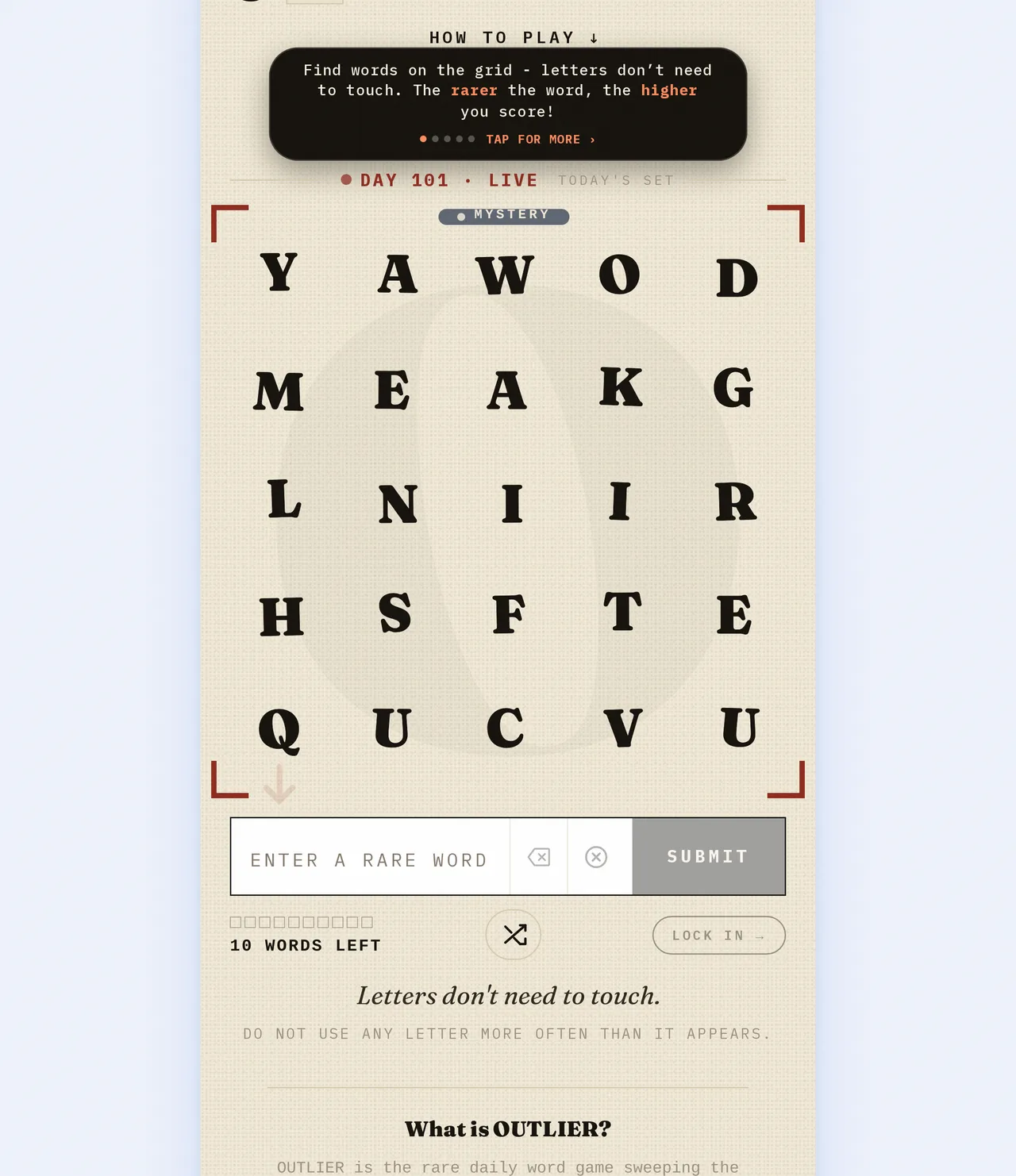
Both games take about the length of a coffee. Both drop once a day for everyone at once. That's where it ends. Wordle hands you one hidden five letter word and six guesses, and every guess narrows the field until the answer is cornered. OUTLIER hands you a five by five grid of twenty five letters and ten guesses, and asks a much more open question: how much can you see in there that other people can't.
The rest of this page is those rows, one at a time, with the actual screens.
1. There's no answer. There's a field.
In Wordle, the game already knows the word. Your job is to corner something that exists before you sit down, and the pleasure is the deduction: which letters to burn, when to gamble, how to spend a guess to kill the most possibilities.
In OUTLIER there's no single answer waiting for you. A board holds thousands of valid words, and no two players ever leave with the same ten. The pleasure isn't deduction, it's discovery: the moment you stop seeing the obvious word in the corner and start seeing the strange one underneath it.
Wordle is a closing-in game. OUTLIER is an opening-up one.
That single change cascades into everything else on this page. Once there's no fixed answer, “did you get it” stops being a useful question, and “how deep did you go” takes over.
2. You aren't scored on getting it right. You're scored on rarity.
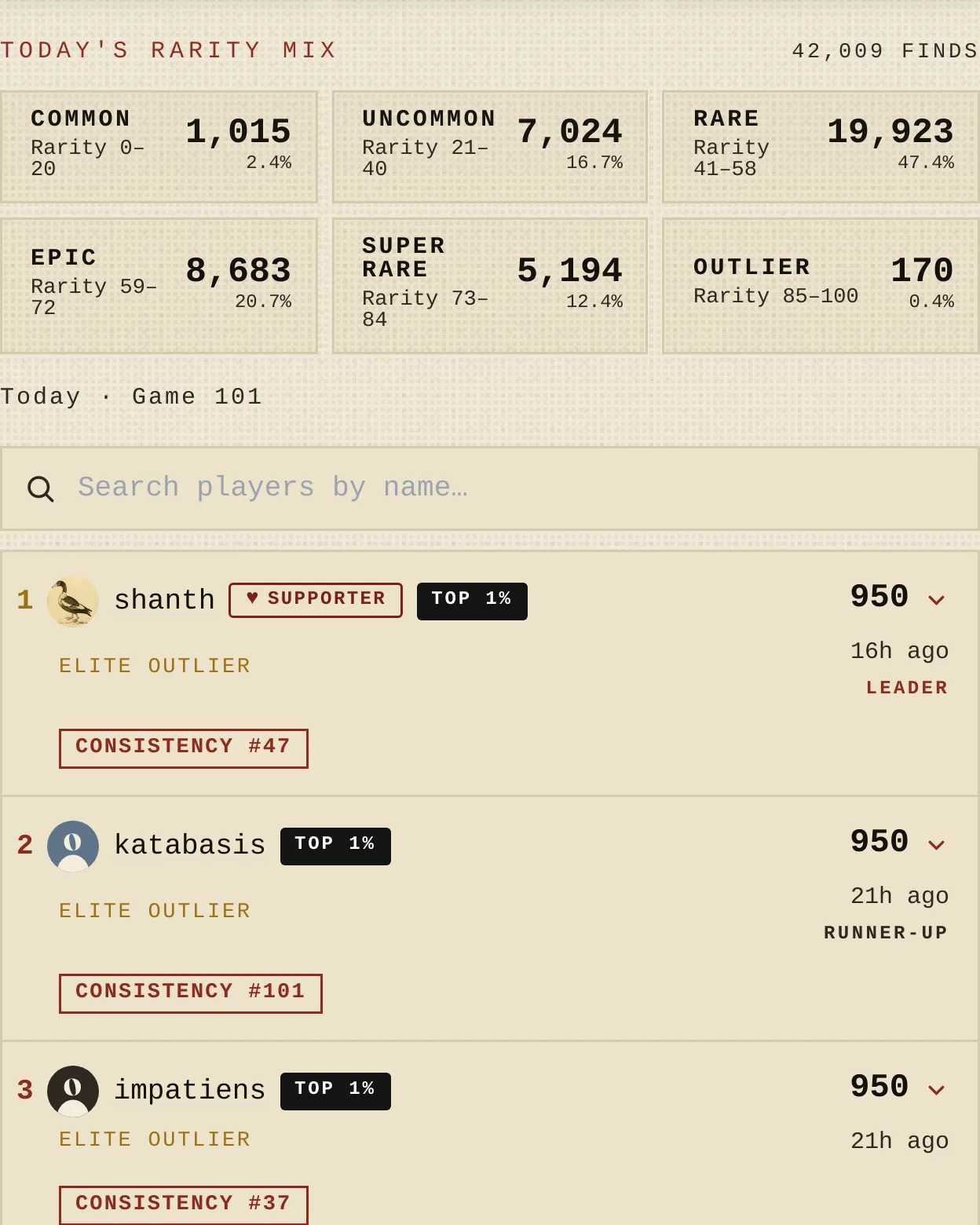
This is the one. Of the ten differences on this page, this is the one that changes everything, and the other nine are downstream of it. Every word you find is scored on how rare it is, on a 0 to 100 scale, so a flawless ten would be a 1,000 point day. Nobody has ever played one. A word most of the field finds pays around 40, the rarest pay in the 90s, and no single word carries a day by itself. What it does carry is the gap: ten ordinary finds and ten rare ones are the difference between the middle of the leaderboard and the top of it. Length barely matters. A five letter word can beat a twelve letter one if fewer people saw it.
Everything else here follows from that one decision. You can rank the whole planet on a single grid because rarity is a continuous, comparable number, where “solved it in four” isn't. Word DNA can read your style back to you because rarity data piles up into a signature. Seasons work because there's a running score instead of a win or a loss. You can watch yourself improve because improvement has a number attached. Take rarity scoring out and the other nine differences collapse; leave it in and they're inevitable.
So a great OUTLIER player isn't the person who finds the most words. It's the person who walks past the safe ones. That's a different skill from Wordle's, and it's trainable in a way that guessing a hidden word isn't.
3. The words are real, and the game teaches them to you.
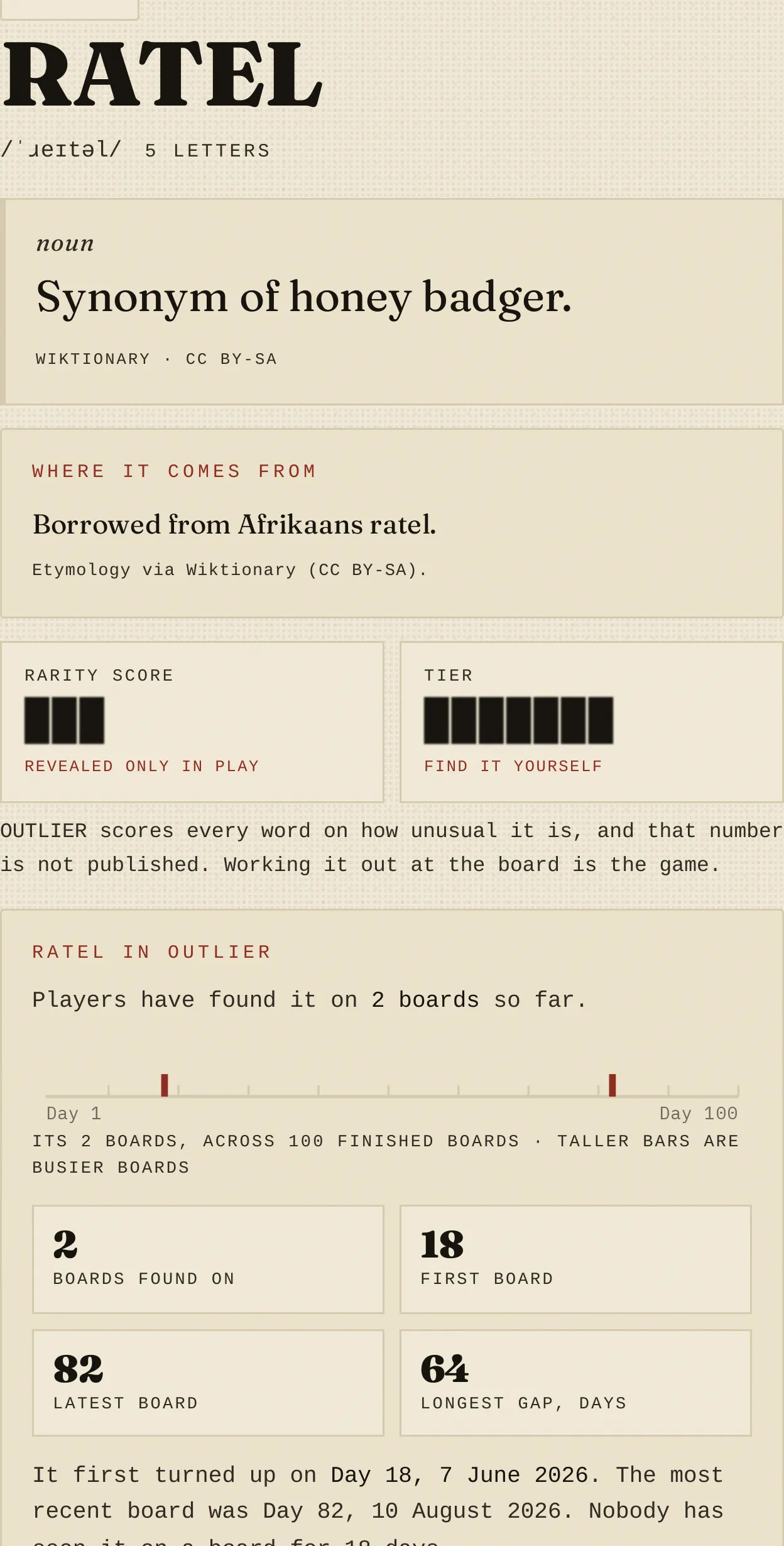
Here is where OUTLIER stops being a game and starts being useful. Every word on the board has its own page: the definition, the pronunciation in IPA, where it came from, how many people have ever found it, and who found it first.
Take RATEL. Five letters. It's the honey badger. One person has ever found it on an OUTLIER board.
You don't have to go looking. When you finish a board, the words you found and the ones you missed are all links. Most players learn a handful of new words a week without ever deciding to.
Wordle has a five letter answer list. OUTLIER has a dictionary, and it points at the strange end of it on purpose.
4. The whole planet plays your exact grid, and you can see all of it.
Wordle's social layer is a grid of coloured squares pasted into a group chat. It's elegant, and it's the entire thing. There's no board, no rank, no record of who did best today.
OUTLIER ranks everyone who played, every day, publicly. Same twenty five letters, same twenty four hours, one list from the top of the world down to you.
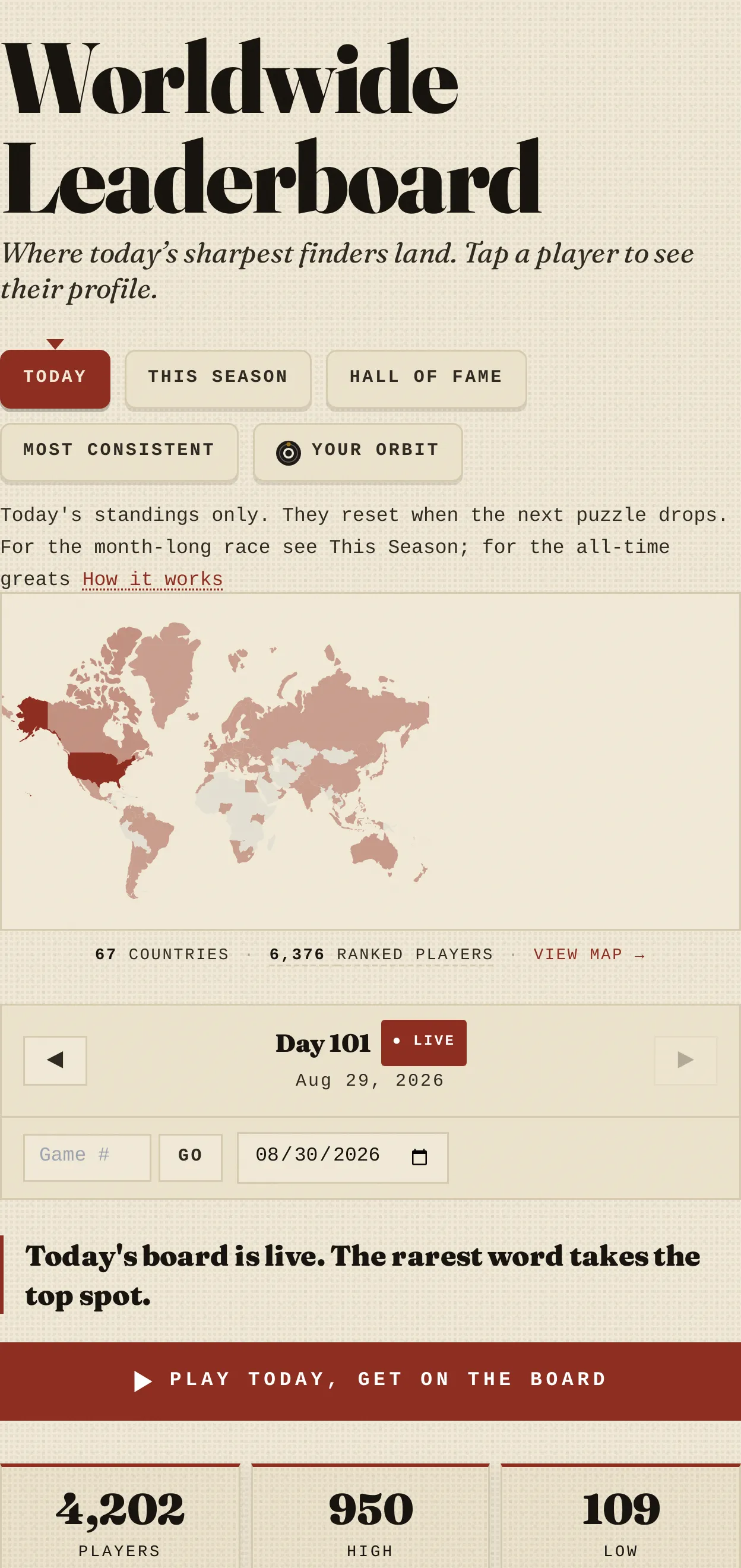
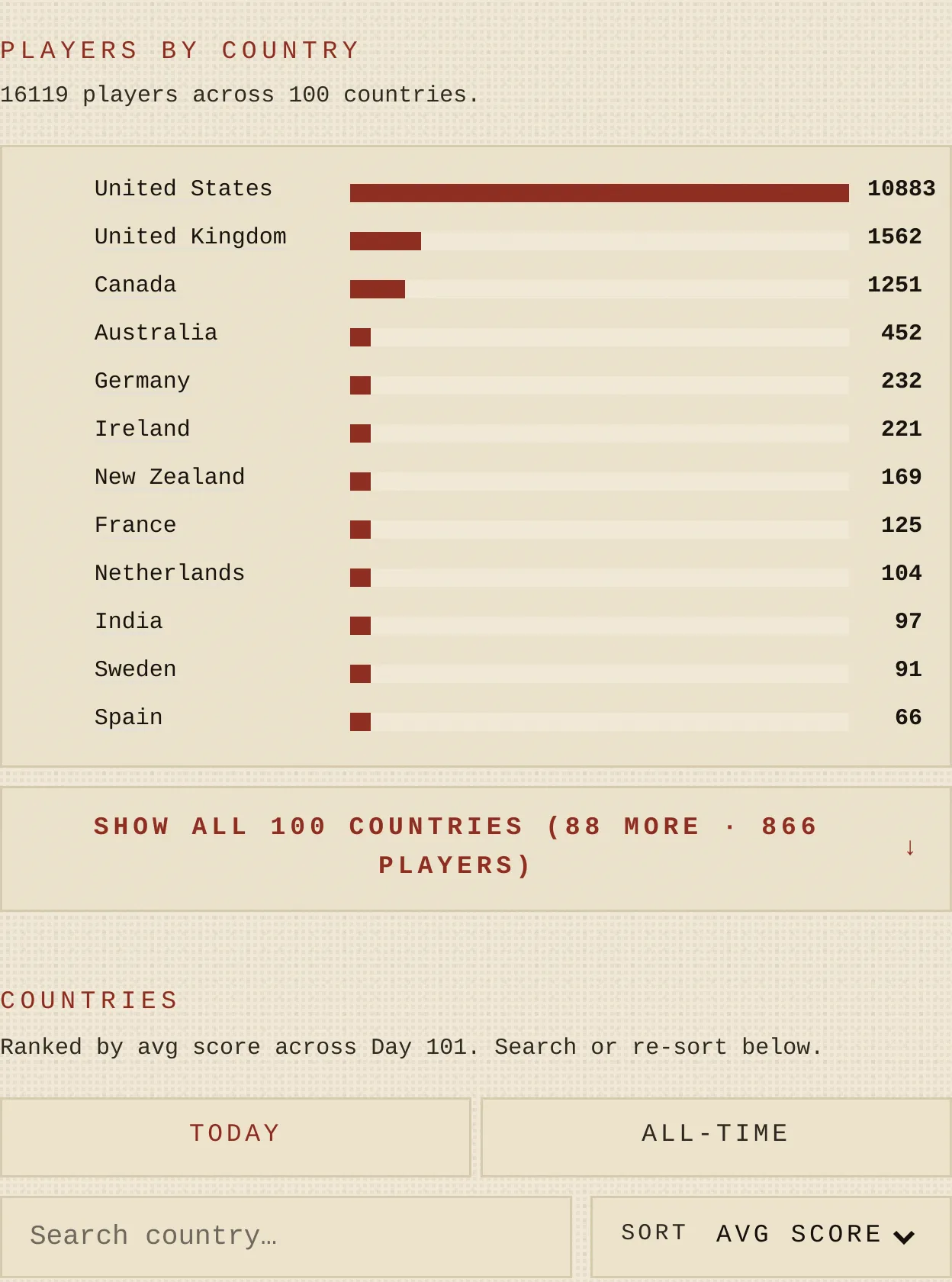
And because the grid is identical everywhere, the map is a real map. Not a marketing globe: a count of where people actually played.
5. You don't play alone. You have an Orbit.
A worldwide rank is a blunt instrument by itself. Finishing 4,000th out of tens of thousands is hard to read as good or bad. Finishing fourth out of the nine people you actually know isn't.
Orbit is the board of the players you follow. One tap to follow, no request, no approval. They appear ranked beside you on the same daily grid, and when one of them is playing right now, you see it happen live.
Alongside Orbit sit Groups: named circles with their own crest and their own daily board. Your family, your office, your book club. In a group of fifty or fewer, joining follows everyone in it both ways, so the group lands in your Orbit too; a bigger group stays its own list and you follow whoever you want.
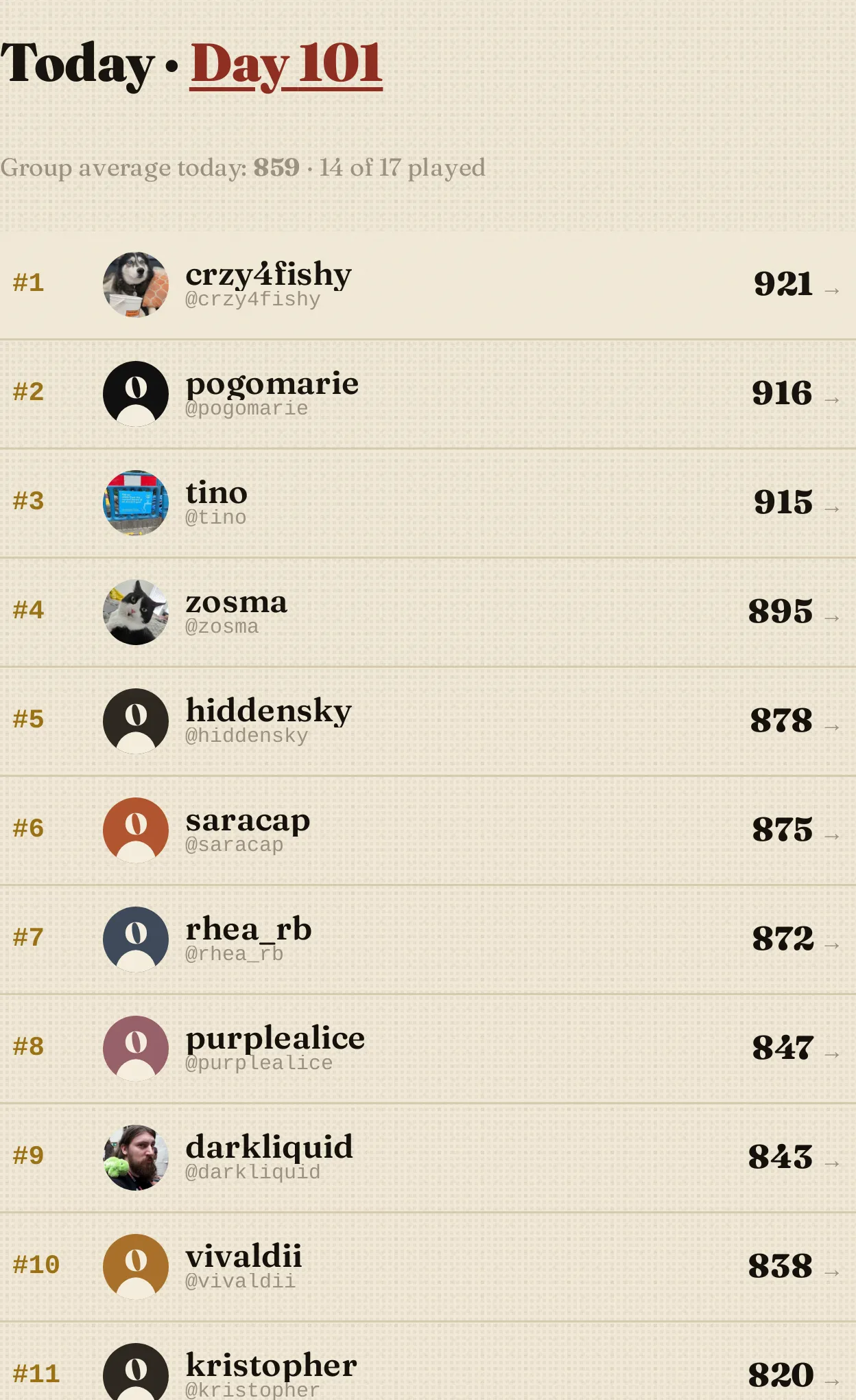
Start yours from your Orbit, or make a group in about fifteen seconds from Groups.
6. You get a profile, and it remembers everything.
Wordle keeps a streak. OUTLIER keeps a career.
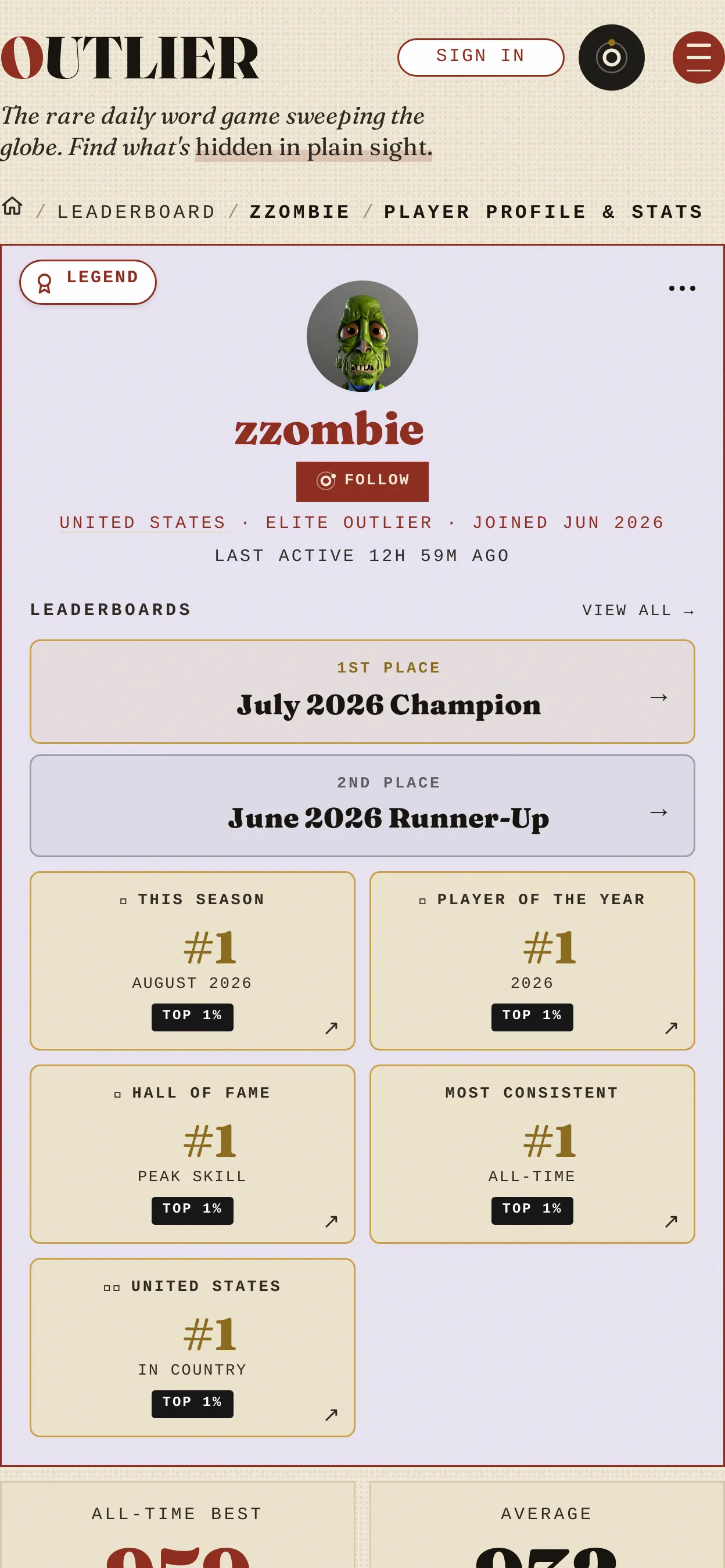
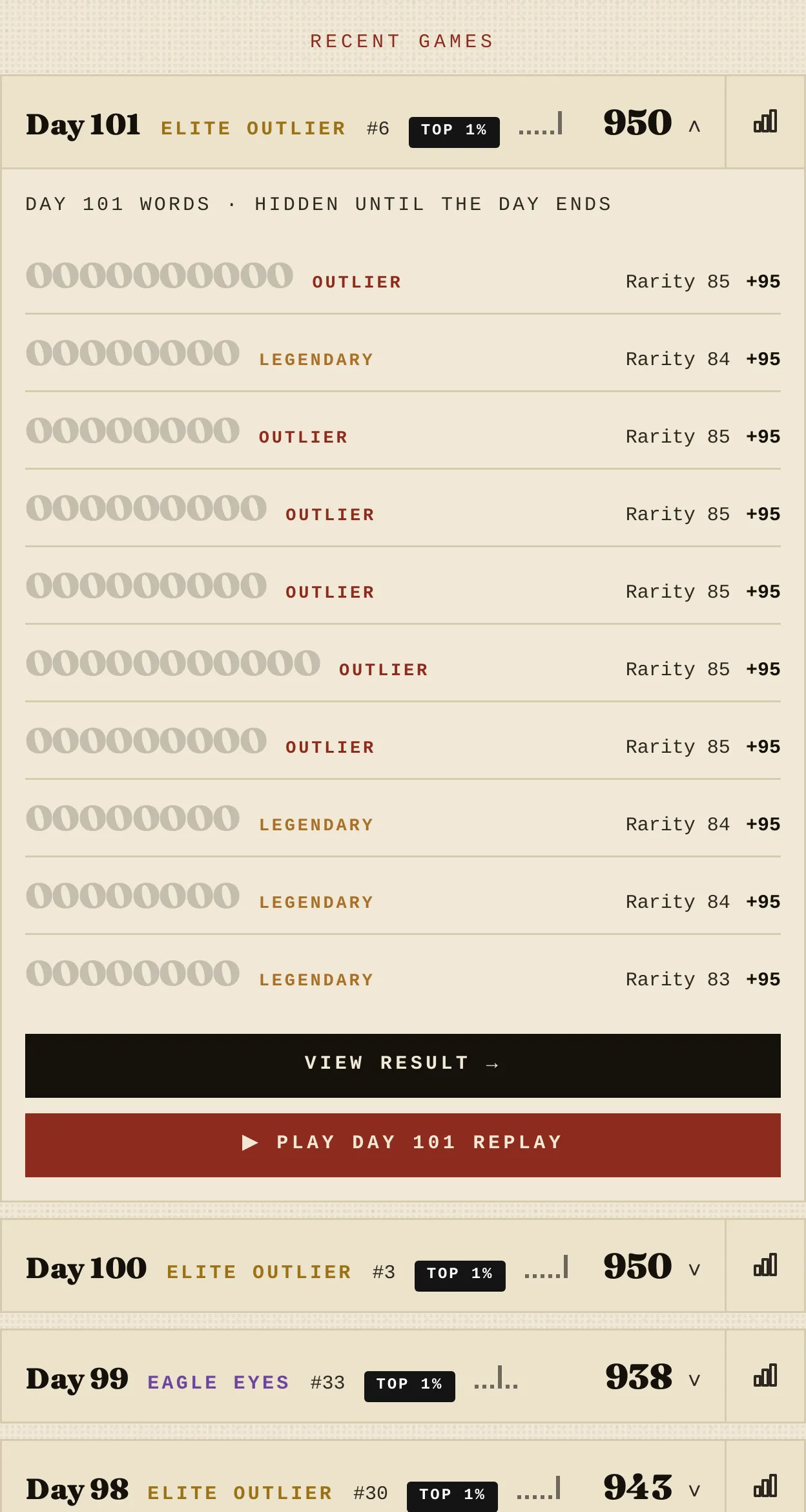
Every player has a public profile: their rank on five different boards, the medals they have won, their best day ever, their average, their country standing, and every game they have played, with the words in each one.
Underneath, every game you have ever played, ranked, tiered, and openable.
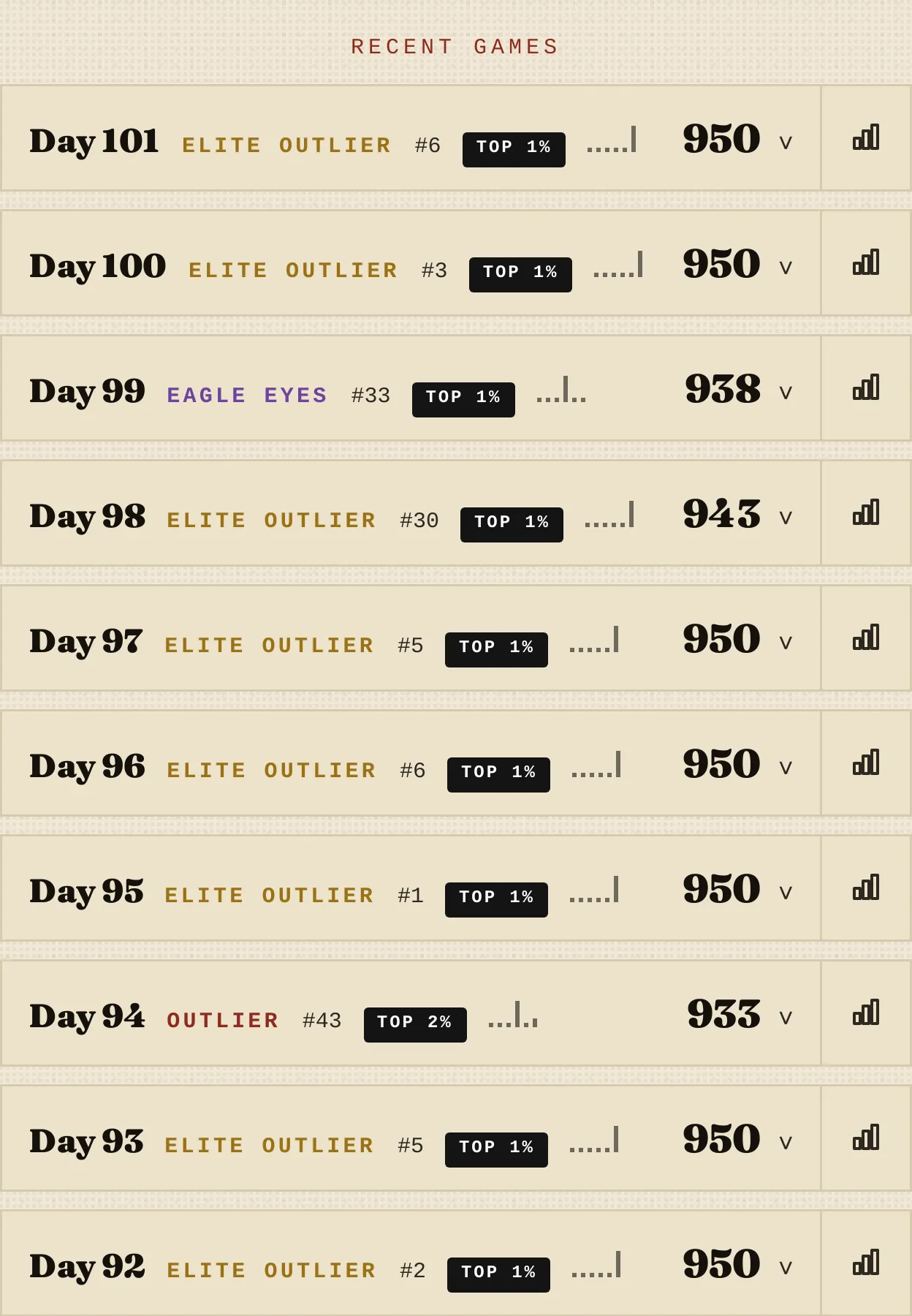
Open a day and it shows you the actual hand you played: every word, what tier it landed in, and what it paid.
7. Word DNA: the game reads you back.
Nothing else in the genre has an equivalent, and it's the reason people send their profile to friends unprompted. It's also only possible because of difference 2: read a rarity score often enough and it stops being a score and starts being a portrait.
OUTLIER watches every word you have ever found and builds a portrait of how your mind works with language. Not your score. Your style.
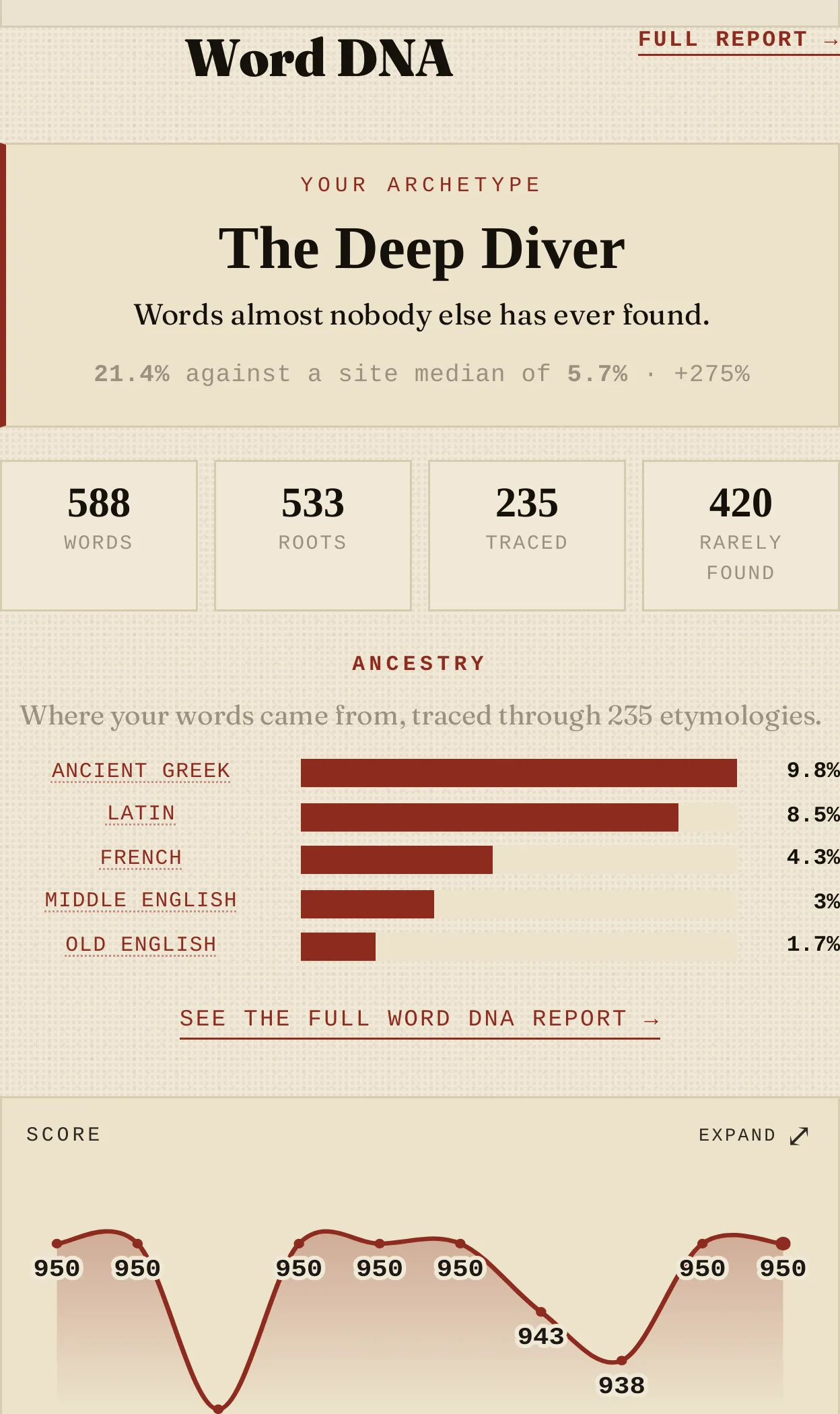
The full report goes further. Where your words come from historically, which families of words you keep reaching for, how you handle prefixes and suffixes, what your words sound like, and how your personal dictionary compares to everyone else's.
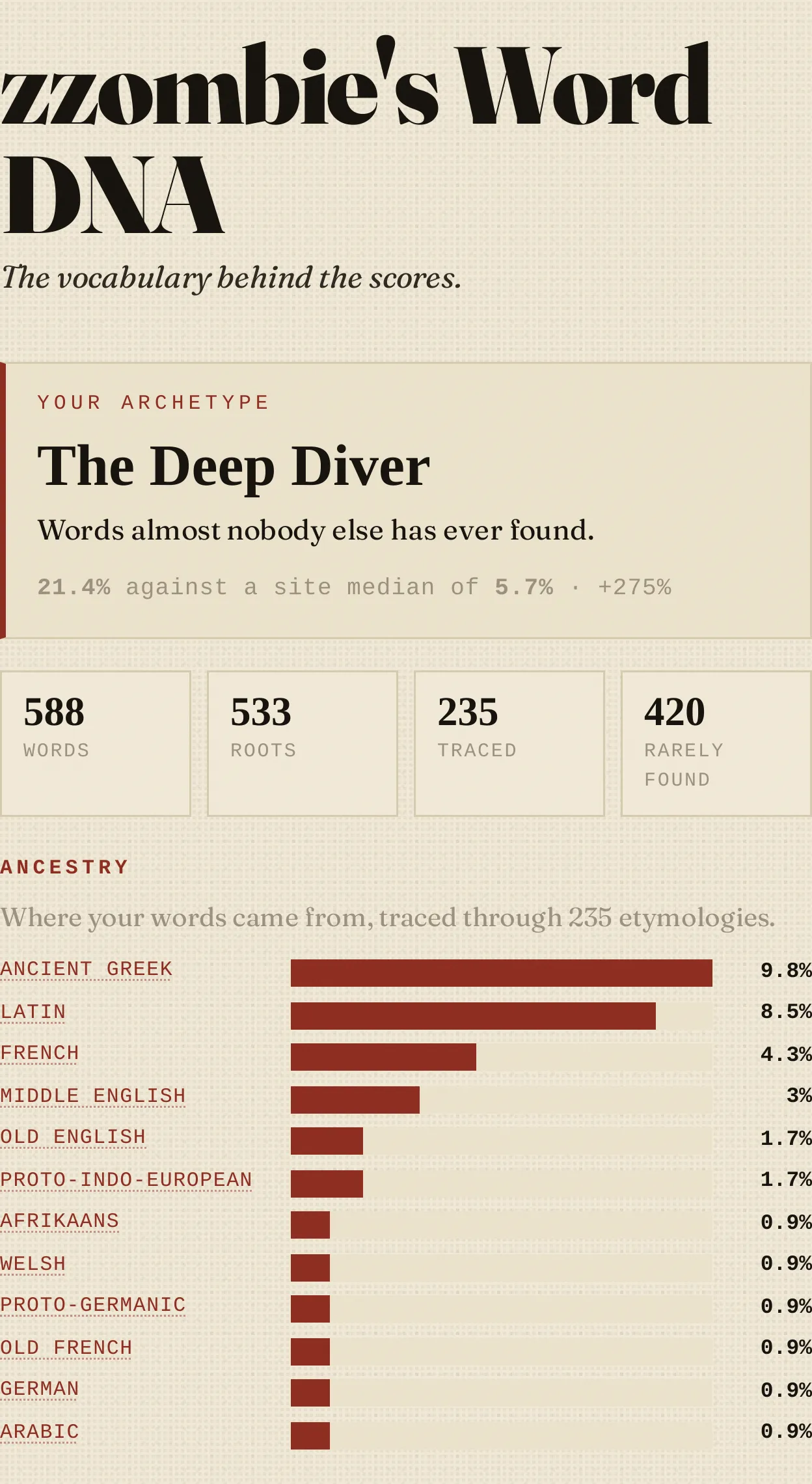
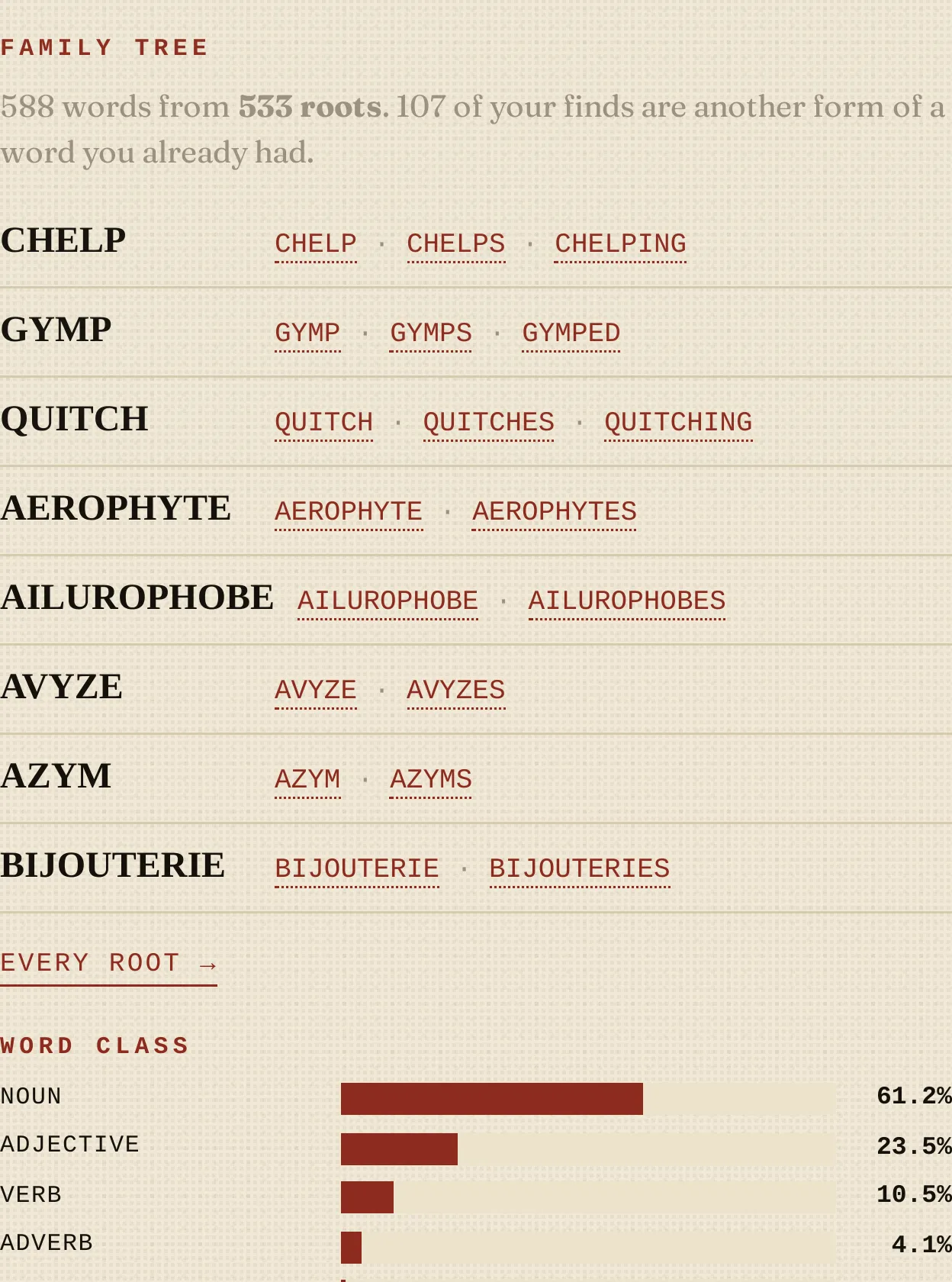
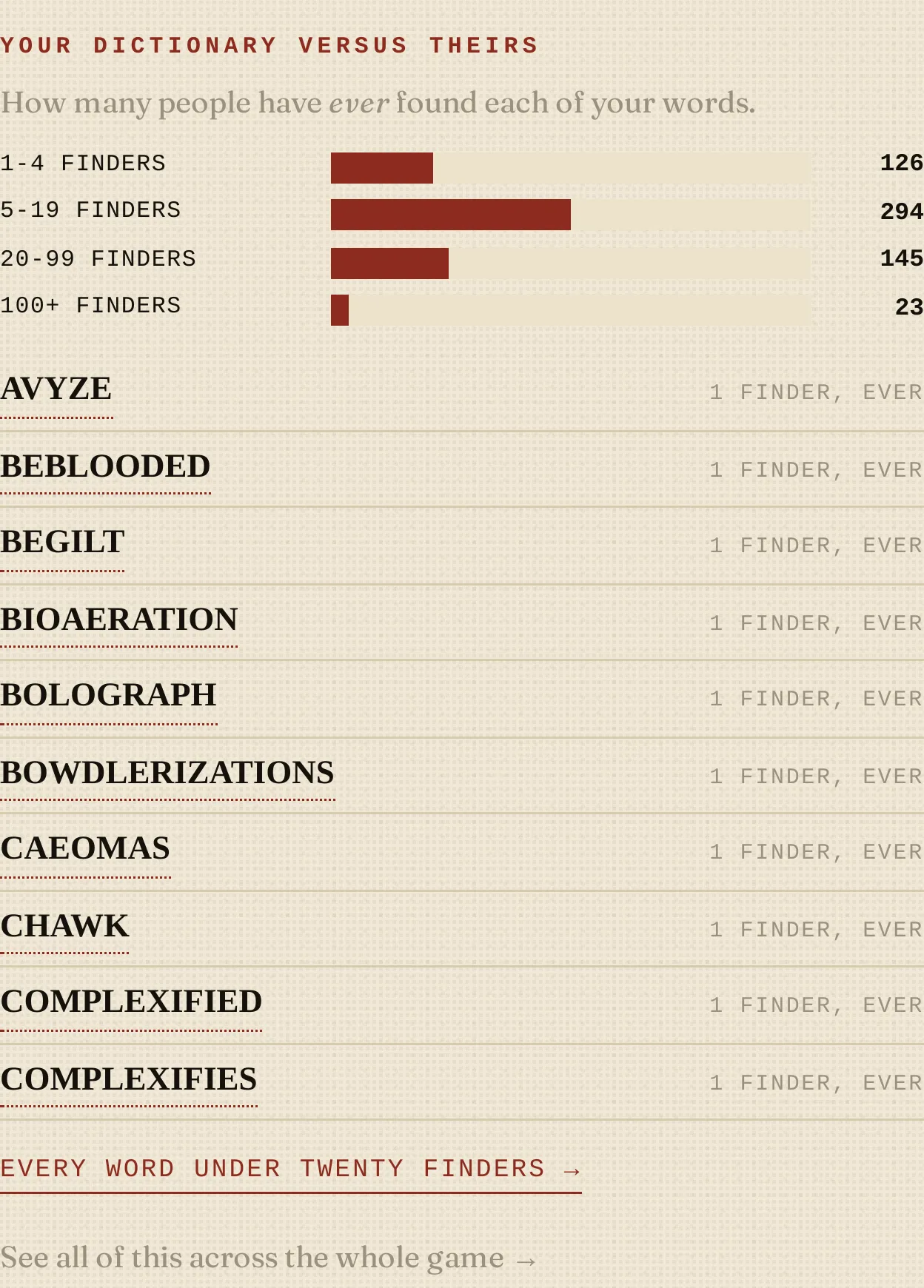
There's a site-wide version too, so you can see the collective vocabulary of every player on earth and find where you sit inside it.
8. It's a season sport, not a streak counter.
A streak is a single number that only ever punishes you. OUTLIER runs an actual competitive calendar.
Win a month and the medal is permanent, sitting in your profile forever with a link back to the season you took it in. Monthly resets are deliberate: a single all-time list slowly rots, everyone still showing up sees an unreachable ceiling, and they stop trying. Every month, everybody back to zero.
9. It plays live, in real time, against actual humans.
Wordle is asynchronous by design. You solve it, you close the tab.
Outlier Live is the same rarity scoring in a room with other people in it, in real time, watching each other's scores move. It's the difference between running a lap alone with a stopwatch and lining up on a start line.
There are head to head challenges too, so you can point the whole thing at one specific person in your group chat who thinks they are better than you.
10. It makes you better, and you can watch it happen.
This is the difference that gets talked about least, and it's the clearest proof of what rarity scoring buys you. A puzzle with one answer can't really improve you, because the skill it trains has a low ceiling. A game scored on rarity has no ceiling at all: there's always a stranger word in the grid, and always someone who found it.
So the game keeps a running measurement of your vocabulary and shows you the curve.
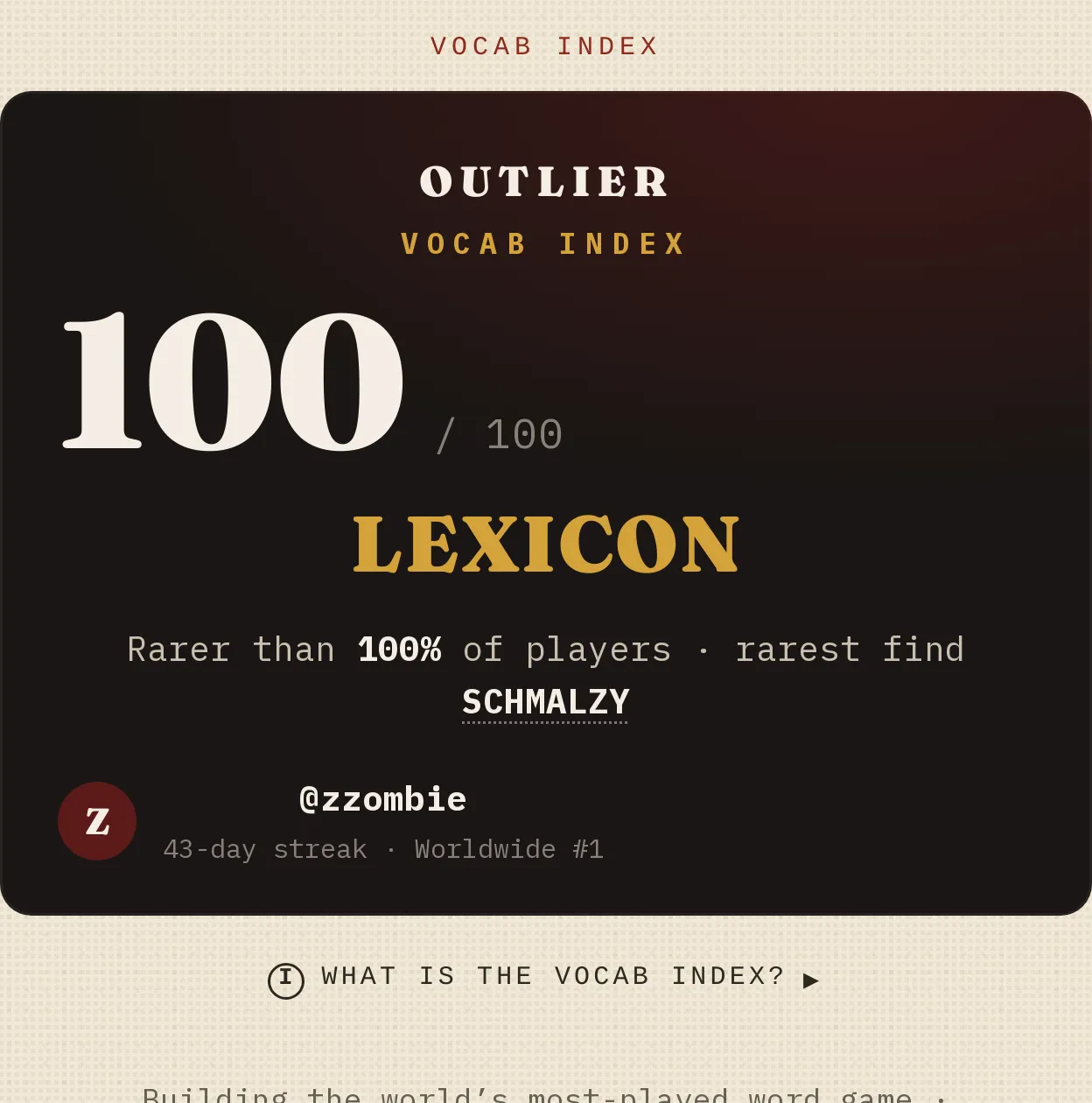
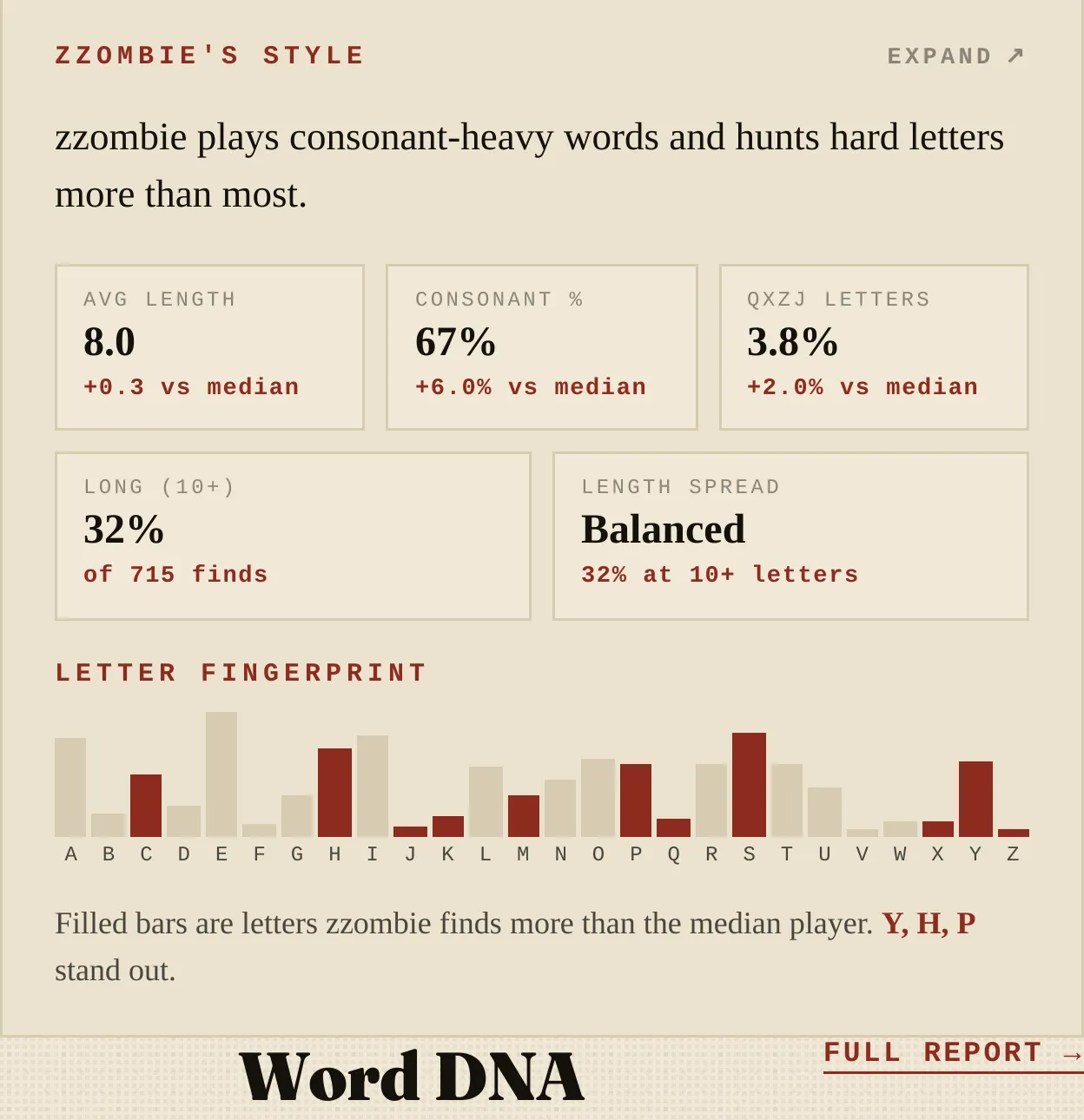
Players don't set out to learn words. They set out to beat the person above them on the group board, and the words arrive as a side effect. That's the whole trick, and it's why people are still here on Day 101.
The scoreboard is a mirror. You improve because you can see exactly what you missed, and who saw it.
So which one should you play?
Both, honestly. They aren't competing for the same five minutes in the way people assume. Wordle is a clean, perfect little deduction and a great daily ritual. If that's all you want, it's already exactly right.
But if you have ever finished a word game and thought that the clever thing you spotted should have counted for something, that's the itch OUTLIER exists to scratch. That's difference 2 again, and it's the whole answer to the question in the title: scoring rarity instead of correctness is what turns a puzzle into a sport. The rare word you found is worth more than the obvious one. There's a board. There are people on it. There's a record of everything you have ever found, and a report that tells you what kind of mind you have.
The grid is live right now, the whole planet is on the same letters, and it takes about five minutes.